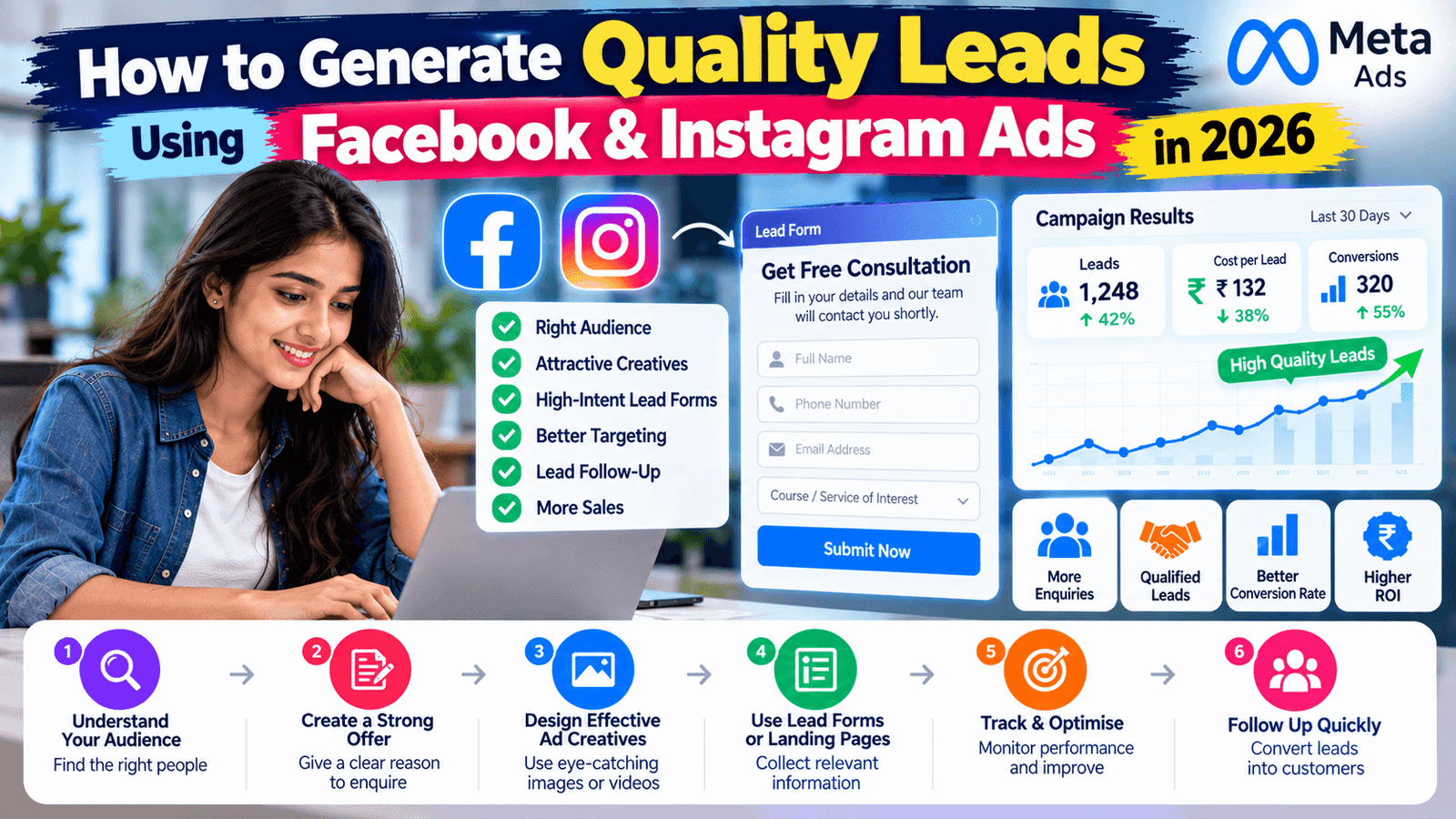
How to Generate Quality Leads Using Facebook and Instagram Ads in 2026
Generating leads is one of the most common goals of digital marketing. Businesses use Facebook and Instagram Ads to reach potential customers, collect enquiries, book appointments, and increase sales.
However, getting hundreds of leads does not always mean a campaign is successful. If people do not answer calls, cannot afford your services, or have no genuine interest in your offer, your advertising budget may be wasted.
The real goal is to generate quality leads—people who match your target audience and have a genuine possibility of becoming customers.
In this guide, you will learn how to create effective Facebook and Instagram advertising campaigns that focus on lead quality, conversion rates, and business growth.
1. Understand Your Ideal Customer
Before launching a campaign, identify exactly whom you want to reach.
For example, a digital marketing institute targeting students may focus on people interested in developing marketing skills. A music school may target parents looking for music or dance classes for their children.
Define your ideal customer by considering:
- Location and service area
- Age range, where relevant to your offer
- Customer needs and challenges
- Budget and purchasing ability
- Buying intent
- Reasons for choosing your business
Practical tip: Do not target everyone. Start with a clear customer profile and use campaign results to improve your audience strategy.
2. Choose the Right Meta Ads Campaign Objective
Facebook and Instagram advertising are managed through Meta Ads Manager. Your campaign setup should match the result you want to achieve.
Common options include:
- Leads: Generate enquiries through instant forms, calls, messaging, or other supported lead methods.
- Sales: Optimise for purchases or other valuable conversion actions when suitable tracking and data are available.
- Traffic: Send people to a website or landing page when website visits are the main goal.
- Engagement: Encourage interactions or conversations when appropriate for your business objective.
If your goal is to generate enquiries, a Leads campaign is often a sensible starting point. However, the best setup depends on your sales process, available tracking, and the type of lead you need.
Do not select an objective just because another advertiser is using it. Choose based on your business goal.
3. Create an Attractive and Relevant Offer
People are more likely to enquire when they understand what they will receive and why it is valuable.
A generic advertisement saying “Contact Us Today” may not communicate enough value to motivate action.
Instead, present a specific and relevant offer.
Examples include:
- Education: Get the course syllabus and upcoming batch details.
- Real estate: Request property details and arrange a site visit.
- Fitness: Book an introductory consultation.
- Professional services: Request an initial discussion.
- Local businesses: Ask for a quote or service consultation.
Your offer should be clear, truthful, and relevant to the audience. Avoid misleading discounts, exaggerated promises, or claims that cannot be supported.
4. Use High-Quality Ad Creatives
Your creative—the image, video, headline, and message—plays an important role in attracting the right people.
A large number of clicks is not useful if those clicks come from people who are unlikely to become customers.
Effective ad creatives should:
- Address a specific customer problem.
- Explain the key benefit of your offer.
- Use clear, readable text.
- Show the product, service, process, or outcome where appropriate.
- Include a clear call to action.
- Match the audience’s needs and expectations.
Video ads versus image ads
Video advertisements can demonstrate a product or service and answer common questions. Image ads can communicate an offer quickly and are often straightforward to test.
Test both formats where appropriate. Use actual campaign results to decide which works best for your audience.
5. Use Facebook and Instagram Lead Forms Strategically
Meta instant forms allow users to submit their details without necessarily leaving Facebook or Instagram.
They can make it easier for people to enquire, but a very short form may also attract people who have little genuine interest.
To improve lead quality, consider collecting relevant information such as:
- Name
- Phone number or email
- Location, if relevant
- Service or course of interest
- Preferred appointment or contact time
- One or two qualifying questions
Avoid asking for unnecessary personal information. Explain how the information will be used and follow applicable privacy and consent requirements.
Should you use a high-intent form?
Where available, a higher-intent form option can add a review step before submission. This may help filter out some accidental enquiries, although it does not guarantee that every lead will be qualified.
Test different form designs and compare the quality of the resulting leads—not just the cost per lead.
6. Test Landing Pages for Better Leads
Instead of collecting enquiries directly through an instant form, you may send users to a dedicated landing page.
A good landing page should answer the visitor’s most important questions.
Include:
- A clear headline
- Details of your product or service
- Key benefits
- Pricing or starting price, when appropriate
- Customer reviews or credible proof
- Frequently asked questions
- A simple enquiry form
- A visible call to action
Make sure the page loads quickly and works well on mobile devices.
For example, a course landing page should clearly explain the curriculum, duration, fees, location or delivery format, and available support. This helps potential students understand the offer before submitting their details.
7. Target the Right Audience
Audience strategy can affect both the quantity and quality of leads.
Depending on your campaign, you may test:
Broad targeting: Allow Meta’s delivery system to find likely responders within your defined constraints.
Interest-based targeting: Use relevant interests or other available audience options when they make sense for your market.
Custom audiences: Reach eligible people from sources such as your customer list or website activity, subject to the applicable requirements and permissions.
Lookalike audiences: Where available and appropriate, use eligible source audiences to find people with similar characteristics.
Retargeting: Re-engage people who have interacted with your business but have not completed the desired action, where eligible.
Do not assume that a highly detailed audience will always outperform a broader one. Test suitable approaches and compare qualified-lead rates, acquisition costs, and sales outcomes.
8. Use Location Targeting for Local Businesses
Local businesses should pay particular attention to their service area.
For example, a music school in Faridabad may prioritise people who can realistically travel to its branch. A service provider may focus on the areas where its team can deliver services.
To improve local lead quality:
- Define the locations you can serve.
- Use location-specific messages when useful.
- Mention the branch or service area clearly.
- State important details such as timing, eligibility, or service availability.
- Review where qualified leads actually come from.
The best location radius depends on the business, customer travel patterns, competition, and service model.
9. Install and Check Conversion Tracking
Reliable tracking helps you understand what happens after someone clicks or submits a form.
For website-based campaigns, relevant tools may include:
- Meta Pixel
- Conversions API
- Google Analytics 4
- UTM parameters
- CRM lead-status tracking
Check that the correct events are being recorded and that important conversions are not being counted multiple times.
Where technically appropriate, eligible and properly configured CRM or server-side integrations can help send useful conversion signals back to advertising platforms. Implement these in line with consent, privacy, and data-handling requirements.
Remember that platform-reported results may differ from CRM or analytics reports because of attribution settings and measurement limitations.
10. Connect Meta Ads With Your CRM
One of the most effective ways to improve lead management is to connect advertising with a customer relationship management system.
A CRM can help you track each lead from the first enquiry to the final sale.
Useful lead stages include:
- New enquiry
- Contact attempted
- Contact established
- Qualified lead
- Appointment or consultation booked
- Sale completed
- Not interested or disqualified
This information helps you identify which campaigns generate genuine business opportunities.
For example, Campaign A may generate leads at ₹100 each, while Campaign B generates leads at ₹180 each. If Campaign B produces a much higher percentage of paying customers, it may deliver better overall value.
11. Follow Up With Leads Quickly
Lead generation does not end when someone submits a form.
Potential customers may enquire from multiple businesses, change their minds, or forget why they submitted their details. A slow response can reduce the likelihood of converting an enquiry into a customer.
Build a simple follow-up process:
- Assign every new lead to a responsible team member.
- Contact the lead promptly during appropriate business hours.
- Introduce your business and confirm the enquiry.
- Answer questions and clarify the next step.
- Schedule follow-ups where appropriate.
- Record the outcome in your CRM.
You can also use consent-based WhatsApp, email, or CRM automation to acknowledge enquiries and manage reminders.
Automation should support genuine communication, not send irrelevant or excessive messages.
12. Monitor the Right Performance Metrics
Do not judge a campaign solely by the number of leads or the cost per lead.
Track the metrics that connect advertising to business results.
| Metric | What it tells you |
|---|---|
| Cost per lead (CPL) | Average cost of generating a lead |
| Qualified-lead rate | Percentage of leads meeting your qualification criteria |
| Cost per qualified lead | Advertising cost per qualified lead |
| Contact rate | Percentage of leads successfully contacted |
| Lead-to-sale rate | Percentage of leads that become customers |
| Cost per acquisition (CPA) | Cost of acquiring a customer or conversion |
| Return on ad spend (ROAS) | Attributed revenue relative to advertising spend |
For lead-generation businesses, cost per qualified lead and cost per acquisition can be more useful than cost per lead alone.
13. Improve Lead Quality With Structured Testing
Avoid changing every campaign setting at the same time. A structured testing process helps you understand what is driving performance.
Test one meaningful element at a time when practical, such as:
- Two different ad creatives
- Different headlines
- Two relevant offers
- Instant form versus landing page
- Different qualifying questions
- Suitable audience strategies
Before each test, decide what you want to learn and how you will evaluate the result.
Allow enough time and conversion volume for a meaningful comparison. Very small samples can produce misleading conclusions.
14. Use AI and Automation to Improve Performance
AI tools can support many parts of the lead-generation process.
Examples include:
Ad copy assistance: Generate headline ideas and alternative messaging for testing.
Creative production: Develop initial concepts, scripts, and visual variations that a marketer can review.
Lead classification: Help categorise enquiries using clear, consistent qualification criteria.
CRM automation: Assign leads, update statuses, and trigger appropriate reminders.
Reporting: Summarise campaign results and highlight changes that need investigation.
Lead analysis: Identify patterns in qualified leads, conversion rates, and customer outcomes.
AI should not replace tracking accuracy, human review, or a sound marketing strategy. Check generated content for factual errors, misleading claims, and inappropriate use of customer information.
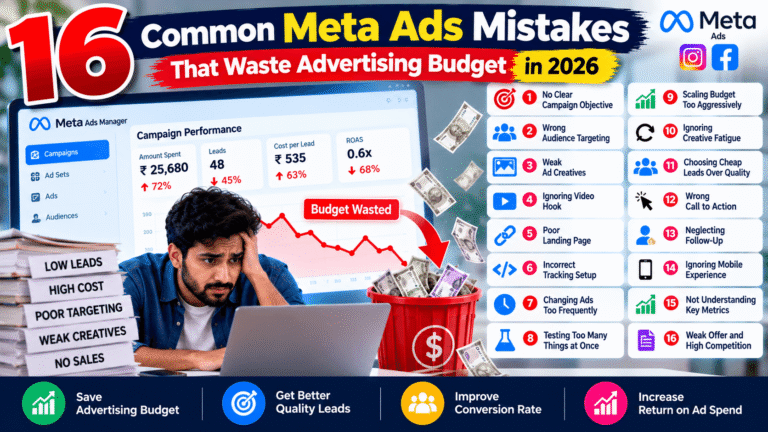
15. Common Mistakes to Avoid
When generating leads using Facebook and Instagram Ads, avoid these common problems:
- Targeting an audience that is unlikely to buy.
- Using unclear or misleading offers.
- Optimising only for cheap leads.
- Collecting too little information to qualify enquiries.
- Asking unnecessary questions that reduce form completion.
- Sending traffic to slow or confusing landing pages.
- Ignoring CRM and sales-team feedback.
- Failing to follow up consistently.
- Making campaign decisions from insufficient data.
- Scaling spending before confirming lead quality and sales performance.
A Practical Lead Generation Workflow
Use this simple process to organise your campaign.
Step 1: Define the ideal customer and business goal.
Step 2: Create a specific, relevant offer.
Step 3: Build suitable creatives and a lead form or landing page.
Step 4: Configure the campaign and check tracking.
Step 5: Launch with a controlled testing budget.
Step 6: Review lead quality with your sales team.
Step 7: Improve the weakest part of the funnel.
Step 8: Scale only when performance is sufficiently consistent and commercially viable.
Final Thoughts
Facebook and Instagram Ads can help businesses generate new enquiries, but successful lead generation requires more than reaching a large audience.
The most important factors are a relevant offer, appropriate targeting, effective creatives, a straightforward conversion process, reliable tracking, and consistent follow-up.
Remember: the goal is not simply to generate more leads. It is to generate leads that can become customers.
At Hunar Digital, our practical performance marketing learning approach covers Meta Ads, Google Ads, analytics, AI tools, CRM systems, and marketing automation.
Want to develop practical digital marketing skills? Visit Hunar Digital to explore learning opportunities.
Frequently Asked Questions
1. How do I generate quality leads from Facebook Ads?
Define your ideal customer, create a relevant offer, use suitable targeting, ask useful qualifying questions, and track which leads become customers. Optimise for lead quality rather than volume alone.
2. Are Facebook Ads or Instagram Ads better for lead generation?
Neither platform is universally better. Results depend on the audience, offer, creative, product, and buying journey. Test placements and compare qualified leads and sales outcomes.
3. What is a good cost per lead?
There is no single ideal cost per lead for every business. Calculate an acceptable cost based on your margins, lead-to-sale rate, customer value, and sales expenses.
4. Should I use Meta instant forms or a landing page?
Instant forms can simplify the enquiry process, while landing pages provide more space to explain an offer and qualify visitors. Test both when appropriate and compare qualified-lead cost and conversion outcomes.
5. How can I reduce fake or irrelevant leads?
Improve the clarity of your offer, use relevant qualifying questions, test higher-intent forms where available, validate contact information appropriately, and review lead quality in your CRM.
6. How much budget do I need for Facebook and Instagram Ads?
Your budget depends on your industry, audience, offer, expected conversion costs, and testing goals. Start with an affordable testing budget and use actual results to decide whether to continue or scale.
7. Can AI help generate better leads?
AI can help with ad variations, reporting, lead classification, and follow-up automation. However, lead quality still depends on strategy, data quality, the offer, and the sales process.