Difference Between Digital Marketing and Performance Marketing: A Complete Guide for 2026
Introduction
Digital marketing and performance marketing are two important concepts in today’s online business environment. Companies of all sizes use digital channels to promote their products, reach potential customers, build brand awareness, and increase revenue.
However, many students, job seekers, entrepreneurs, and business owners are confused about the difference between digital marketing and performance marketing.
Are they the same? Which one offers better career opportunities? Is performance marketing a separate field or a specialised part of digital marketing?
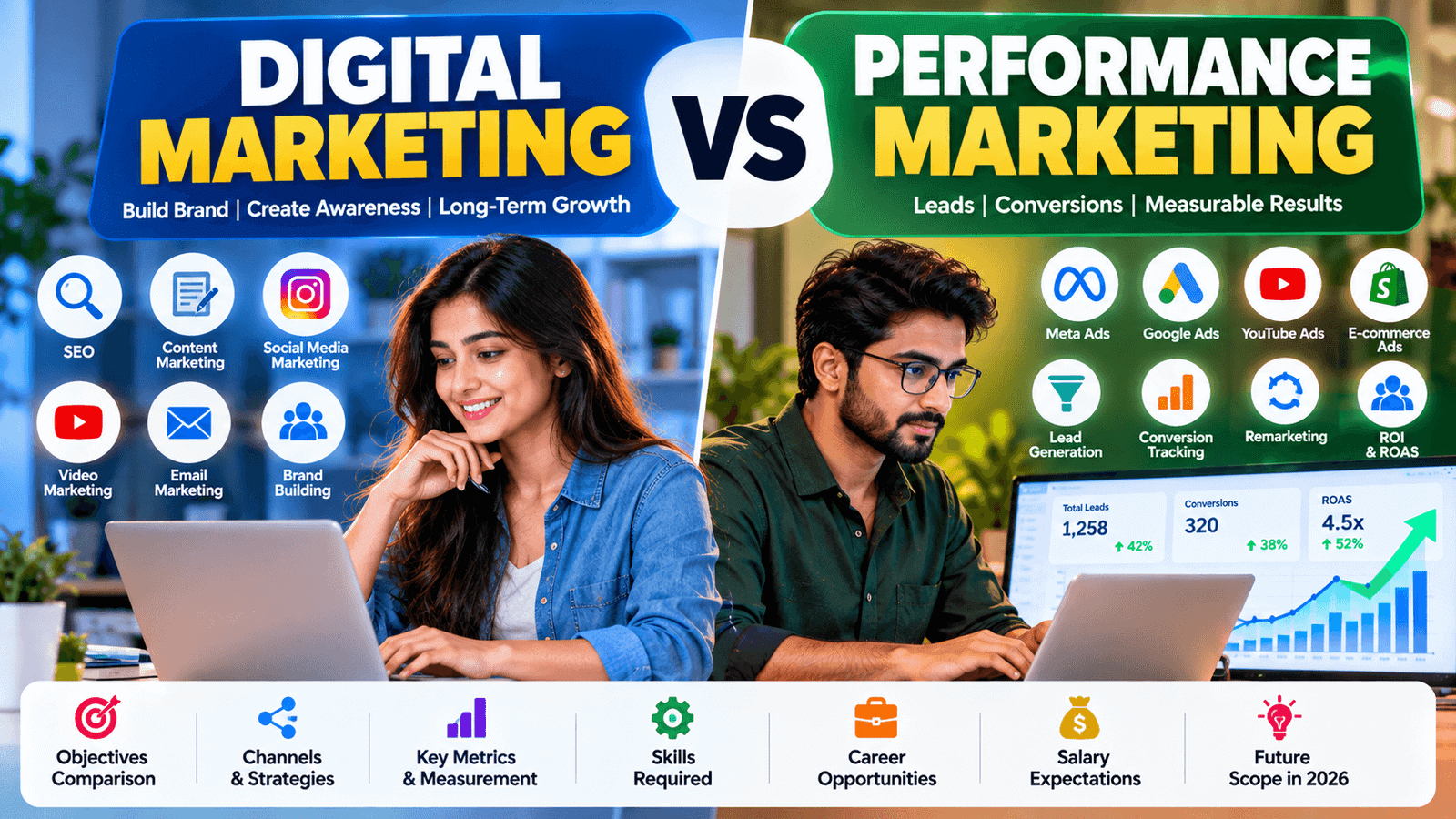
The simple answer is that digital marketing is the broader field of promoting products and services through digital channels, while performance marketing focuses on measurable outcomes such as leads, sales, conversions, and customer acquisition.
Both approaches can work together to help businesses achieve sustainable growth.
In this guide, we will explore their key differences, practical examples, essential skills, career opportunities, and future scope in 2026.
What Is Digital Marketing?
Digital marketing refers to the promotion of products, services, brands, and businesses through online and digital channels.
Its objective may include increasing brand awareness, attracting website visitors, engaging audiences, generating leads, building customer relationships, and increasing sales.
Digital marketing includes several specialisations, such as:
- Search Engine Optimisation (SEO): Improving a website’s visibility in organic search results.
- Social Media Marketing: Building an audience and engaging users through platforms such as Instagram, Facebook, LinkedIn, and YouTube.
- Content Marketing: Creating useful blogs, videos, guides, and other content to attract potential customers.
- Email Marketing: Communicating with subscribers and customers through targeted email campaigns.
- Paid Advertising: Promoting products and services through platforms such as Google Ads and Meta Ads.
- Affiliate Marketing: Working with partners who promote products or services in exchange for commission.
- Marketing Automation: Using technology to streamline communication, lead management, and marketing workflows.
Digital marketing can support both short-term campaigns and long-term business objectives.
For example, a music school can use SEO to rank for local music classes, publish student performance videos on social media, send renewal reminders through email or WhatsApp, and run paid advertisements to attract new admissions.
These activities work together to strengthen its online presence and customer acquisition strategy.
What Is Performance Marketing?
Performance marketing is a data-driven approach to digital advertising and customer acquisition that focuses on measurable outcomes.
Rather than evaluating a campaign only by its reach or engagement, performance marketers examine whether it generates useful results, such as qualified leads, completed purchases, app installations, or profitable customer acquisition.
Common performance marketing channels and activities include:
- Meta Ads campaigns on Facebook and Instagram.
- Google Search, Display, Shopping, and YouTube advertising.
- Affiliate marketing campaigns.
- E-commerce advertising and conversion optimisation.
- Lead-generation campaigns for service businesses.
- Conversion tracking and campaign analytics.
- Remarketing to eligible audiences.
- Landing-page testing and optimisation.
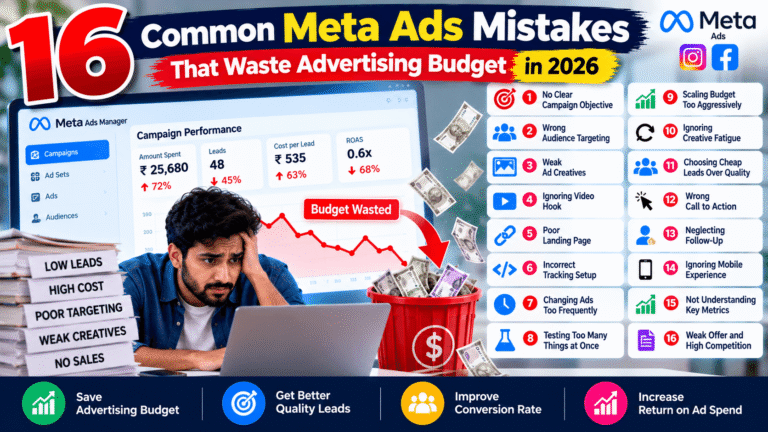
Performance marketers regularly review metrics such as cost per lead (CPL), cost per acquisition (CPA), customer acquisition cost (CAC), conversion rate, and return on ad spend (ROAS).
The goal is to understand which campaigns produce valuable results and optimise marketing expenditure accordingly.
Performance marketing is not simply about generating the cheapest clicks or the highest number of leads. It is about improving the quality and commercial value of the results.
Digital Marketing vs Performance Marketing: Key Differences
The following table highlights the main differences between the two fields.
| Comparison Factor | Digital Marketing | Performance Marketing |
|---|---|---|
| Definition | Broad discipline covering online promotion | Specialised approach focused on measurable outcomes |
| Main objective | Awareness, engagement, traffic, leads, and growth | Leads, conversions, sales, and customer acquisition |
| Scope | SEO, content, social media, email, paid ads, and more | Primarily measurable advertising and conversion-focused activities |
| Common channels | Search engines, websites, social platforms, email, and advertising | Meta Ads, Google Ads, affiliate networks, and conversion campaigns |
| Measurement | Rankings, reach, traffic, engagement, leads, and revenue | CPL, CPA, CAC, conversion rate, ROAS, and profit contribution |
| Time horizon | Short-term and long-term | Often campaign-based, with ongoing optimisation |
| Core skills | Content, SEO, communication, strategy, and audience development | Paid advertising, tracking, analytics, experimentation, and optimisation |
| Business contribution | Builds visibility, trust, audience, and demand | Measures and improves the efficiency of customer acquisition |
| Typical roles | SEO Executive, Social Media Manager, Content Marketer | Performance Marketing Executive, Paid Ads Specialist, Growth Marketer |
One important point: these categories overlap. Paid advertising is part of digital marketing, and performance marketing often uses the same advertising platforms. The difference is primarily the strategy, measurement framework, and business objectives.
Practical Example: Digital Marketing vs Performance Marketing
Imagine that Hunar Sangeet Mahavidyalaya wants to increase admissions at its music school in Faridabad.
Both approaches can contribute to the same business goal, but they may focus on different activities.
Digital Marketing Approach
The school develops a comprehensive online marketing strategy.
Activities may include:
- Publishing student singing and dance performance videos on Instagram and YouTube.
- Improving Google search visibility for music classes in Faridabad.
- Publishing educational blogs about singing, guitar, keyboard, and dance.
- Sharing student testimonials and teacher introductions.
- Building an engaging social media presence.
- Running paid advertising campaigns where appropriate.
The objective is to strengthen the school’s online presence, build trust, engage potential students, and attract enquiries over time.
Performance Marketing Approach
The school launches a measurable campaign designed to generate admissions.
Activities may include:
- Running Meta Ads targeting relevant parents and students in selected locations.
- Creating a landing page with course details and a demo-class enquiry form.
- Tracking form submissions and other relevant conversion events.
- Connecting leads to a CRM or an organised follow-up process.
- Measuring cost per lead and the percentage of enquiries that become admissions.
- Testing different advertisements and optimising the campaign based on lead quality and business results.
The objective is to acquire suitable students at an economically sustainable cost.
The key difference: Digital marketing manages the wider online presence, while performance marketing concentrates on measurable campaign outcomes. A business can use both approaches simultaneously.
Important Performance Marketing Metrics
One of the biggest differences between general digital marketing activities and performance-focused campaigns is the emphasis on quantitative measurement.
Here are some important metrics every aspiring performance marketer should understand.
1. Cost Per Click (CPC)
CPC measures the average amount paid for each advertising click.
2. Cost Per Lead (CPL)
CPL measures the advertising cost required to generate one lead.
Formula:
Cost Per Lead = Total Advertising Spend ÷ Number of Leads
3. Cost Per Acquisition (CPA)
CPA measures the cost of acquiring a defined conversion, such as a purchase or completed registration. The exact definition depends on the campaign.
4. Conversion Rate
Conversion rate measures the percentage of visitors or users who complete a desired action.
5. Customer Acquisition Cost (CAC)
CAC measures the cost of acquiring a new customer. A comprehensive calculation may include advertising, sales, marketing staff, and other relevant expenses.
6. Return on Ad Spend (ROAS)
ROAS measures the revenue attributed to advertising relative to advertising expenditure.
Formula:
ROAS = Advertising-Attributed Revenue ÷ Advertising Spend
For example, if a campaign spends ₹10,000 and generates ₹40,000 in attributed revenue, its ROAS is 4x.
However, a 4x ROAS does not automatically mean the campaign is profitable. Product costs, service delivery, discounts, refunds, salaries, and other expenses must also be considered.
Which Is Better for a Career in 2026?
Neither field is universally better. The right choice depends on your interests, strengths, and career objectives.
Digital Marketing Career
Digital marketing can suit people interested in content creation, SEO, social media, communication, branding, and marketing strategy.
Potential roles include:
- Digital Marketing Executive
- SEO Specialist
- Social Media Manager
- Content Marketing Executive
- Email Marketing Specialist
- Digital Marketing Strategist
It can provide a broad foundation for working across different marketing channels.
Performance Marketing Career
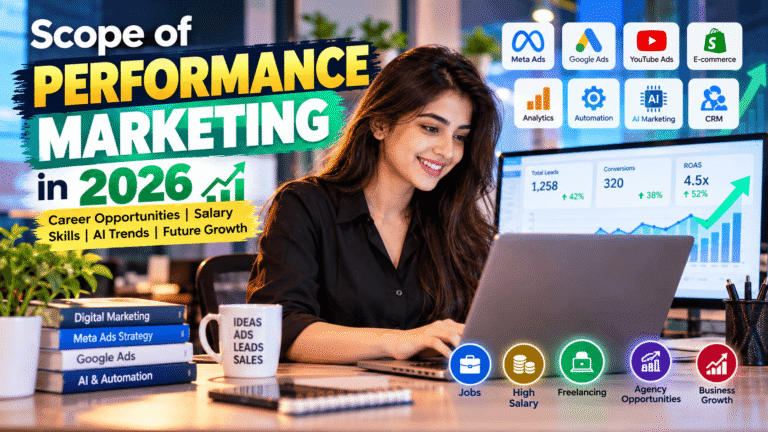
Performance marketing may suit people who enjoy data analysis, advertising platforms, experimentation, technology, and measurable business outcomes.
Potential roles include:
- Performance Marketing Executive
- Meta Ads Specialist
- Google Ads Specialist
- Paid Media Manager
- Marketing Analytics Specialist
- Growth Marketing Specialist
- Marketing Automation Specialist
These roles may require practical knowledge of advertising accounts, conversion tracking, campaign reporting, and optimisation.
In both fields, career prospects depend on employer demand, practical ability, communication skills, experience, and the results a candidate can demonstrate.
Salary Expectations in India
Salary varies according to location, company size, industry, experience, technical expertise, and job responsibilities.
The following figures are broad illustrative estimates for career planning, not verified 2026 market averages or guaranteed offers.
| Experience Level | Digital Marketing | Performance Marketing |
|---|---|---|
| Fresher / Trainee | ₹1.8–3.6 LPA | ₹1.8–3.6 LPA |
| 1–2 Years | ₹3–6 LPA | ₹3–6 LPA |
| 3–5 Years | ₹5–10 LPA | ₹6–12 LPA |
| Senior Specialist / Manager | ₹8–18 LPA or more | ₹10–20 LPA or more |
Actual salaries can fall outside these ranges. There is no reliable rule that performance marketers always earn more than general digital marketers.
Professionals who demonstrate expertise in analytics, advertising strategy, tracking, budget management, and profitable customer acquisition may qualify for more specialised roles.
A course certificate alone does not guarantee employment or a particular salary.
Skills Required for Digital Marketing
To build a career in digital marketing, consider developing the following skills:
- SEO and keyword research.
- Social media strategy and management.
- Content writing and content planning.
- Basic graphic design and video editing.
- Website and landing-page fundamentals.
- Email marketing and customer communication.
- Marketing analytics and reporting.
- AI-assisted content research and workflow tools.
These skills help marketers understand audiences, develop content, and coordinate different digital channels.
Skills Required for Performance Marketing
Performance marketing requires a more specialised set of practical skills.
Paid Advertising
Learn Meta Ads, Google Ads, campaign structures, budgets, bidding strategies, audience targeting, and creative testing.
Conversion Tracking
Understand Meta Pixel, Conversions API concepts, Google Analytics 4 (GA4), Google Tag Manager, and UTM parameters.
Data Analysis
Learn how to interpret CPC, CPL, CPA, conversion rate, CAC, ROAS, and lead quality.
Landing-Page Optimisation
Understand how page speed, mobile usability, forms, messaging, and calls to action affect conversions.
Testing and Optimisation
Practise comparing creative variations, analysing campaign performance, and reallocating budgets based on reliable evidence.
CRM and Marketing Automation
Learn how to organise leads, automate follow-ups, connect marketing tools, and report the results of the sales funnel.
Business Economics
Understand customer lifetime value, margins, sales conversion rates, and profitability. A campaign that generates cheap leads can still lose money if those leads do not convert.
How AI Is Changing Digital Marketing and Performance Marketing
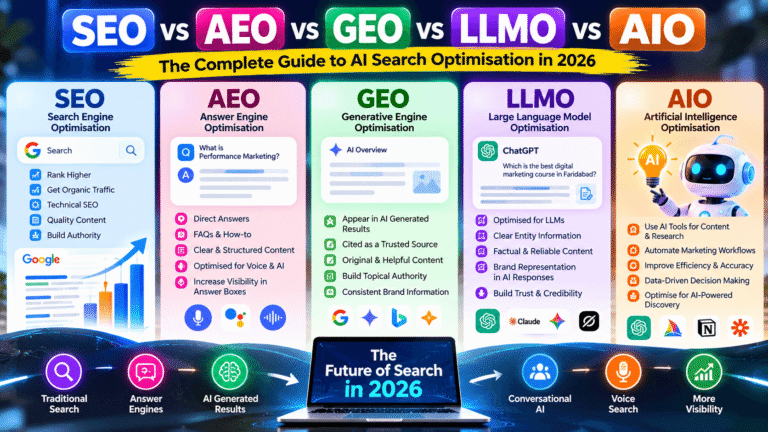
Artificial intelligence is changing how marketers research audiences, develop content, analyse data, create advertising variations, and automate repetitive tasks.
In digital marketing, AI can assist with content ideation, keyword research, audience insights, and marketing workflows.
In performance marketing, AI can support creative testing, campaign analysis, reporting, and the optimisation capabilities available within advertising platforms.
However, AI is not a substitute for sound marketing judgement. Poor offers, inaccurate tracking, weak landing pages, low-quality data, and inadequate follow-up can still produce disappointing results.
Marketers should also understand privacy requirements, consent management, platform policies, and the limitations of automated attribution.
In 2026, a useful combination is marketing fundamentals + AI tools + analytical thinking + practical campaign experience.
Can You Learn Both Digital Marketing and Performance Marketing?
Yes. In fact, learning both can be more useful than treating them as completely separate disciplines.
A structured learning path could look like this:
Stage 1: Digital Marketing Fundamentals
Learn customer research, marketing funnels, SEO, content marketing, social media, and online brand development.
Stage 2: Paid Advertising
Practise Meta Ads, Google Ads, audience research, campaign setup, copywriting, and creative testing.
Stage 3: Analytics and Tracking
Learn GA4, Google Tag Manager, conversion events, campaign reporting, and attribution concepts.
Stage 4: Conversion Optimisation
Practise landing-page improvement, lead qualification, A/B testing, and customer acquisition analysis.
Stage 5: AI and Automation
Explore AI-assisted workflows, CRM integration, lead follow-up automation, and reporting dashboards.
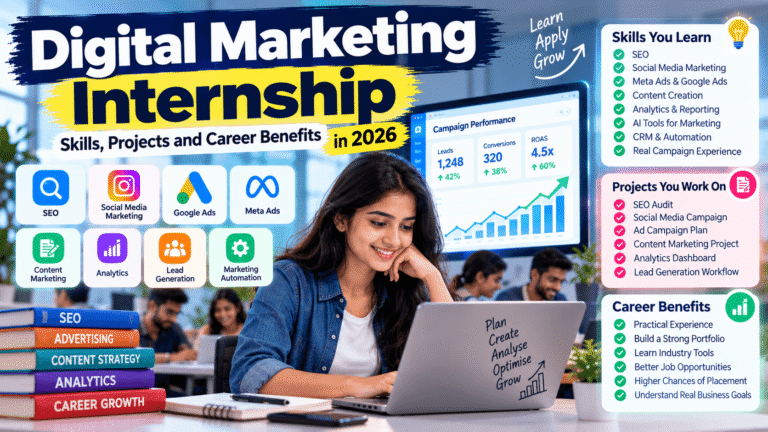
Stage 6: Practical Projects
Build a portfolio containing campaign plans, tracking exercises, dashboards, and clearly labelled real or simulated case studies.
The learning duration depends on your starting knowledge, practice time, access to tools, and project complexity.
Which Course Should You Choose?
Your choice should depend on what you want to achieve.
Choose a digital marketing course if you want to understand the complete online marketing ecosystem, including SEO, social media, content, email, and advertising.
Choose a performance marketing course if you want to specialise in paid advertising, conversion tracking, analytics, campaign optimisation, and customer acquisition.
Choose a programme that combines both if you want a broader foundation followed by hands-on performance marketing specialisation.
Before enrolling, review the actual syllabus, trainer experience, practical assignments, project access, internship terms, and placement support. Check whether advertising spend, software subscriptions, or certification fees are charged separately.
Learn Digital and Performance Marketing with Hunar Digital
Hunar Digital provides a learning pathway for people interested in digital marketing, performance marketing, AI-assisted marketing, analytics, and automation.
Aspiring professionals should look for practical learning that covers advertising platforms, campaign planning, conversion tracking, lead management, and performance reporting.
Whether you are a student, job seeker, business owner, or aspiring freelancer, focus on developing skills you can demonstrate through credible projects rather than relying on certificates alone.
Interested in building practical marketing skills?
Explore available courses at Hunar Digital:
Website: https://hunardigital.com/
Frequently Asked Questions
1. Is digital marketing the same as performance marketing?
No. Digital marketing is the broader discipline of promoting products and services through digital channels. Performance marketing is a specialised, results-focused approach that measures and optimises defined outcomes.
2. Is performance marketing a part of digital marketing?
Yes. Performance marketing is generally considered part of the broader digital marketing ecosystem, although its focus and measurement approach distinguish it from other digital marketing activities.
3. Which is better for beginners?
Digital marketing fundamentals are a useful starting point because they explain customers, channels, and marketing strategy. Beginners can then specialise in performance marketing if they are interested in advertising, analytics, and measurable results.
4. Which field has better salary prospects?
Neither guarantees a higher salary. Compensation depends on experience, specialisation, employer demand, technical ability, and demonstrated business impact.
5. Can I become a performance marketer without coding?
Yes. Many performance marketing roles do not require advanced programming. However, understanding websites, tracking systems, tags, APIs, and basic technical concepts can be valuable, especially in analytics and automation roles.
6. Does performance marketing include SEO?
SEO can be measured against performance goals, but performance marketing is commonly associated with paid, conversion-focused campaigns. SEO is a distinct digital marketing specialisation and can complement performance marketing.
7. Will AI replace digital and performance marketers?
AI is likely to automate or simplify some tasks, but strategy, creative judgement, data interpretation, customer understanding, and commercial decision-making remain important. Marketers who learn to use AI responsibly may be better positioned to adapt.
8. Can I start a freelance business after learning performance marketing?
Potentially, yes. Freelancers can offer advertising management, lead generation, analytics, and conversion optimisation services. Success depends on acquiring clients, managing budgets responsibly, retaining customers, and producing measurable results.
Conclusion
Digital marketing and performance marketing serve related but different purposes.
Digital marketing provides the broader framework for building online visibility, engaging audiences, developing customer relationships, and supporting business growth.
Performance marketing focuses on measurable campaign outcomes and uses data to improve the efficiency of customer acquisition and conversions.
For students and professionals in 2026, learning digital marketing fundamentals and then developing practical performance marketing expertise can create a versatile skill set.
For businesses, combining strong brand development with disciplined performance measurement can help connect marketing activity to meaningful commercial outcomes.
The most effective approach is not to choose one discipline blindly, but to understand how both work together and develop the skills that match your career or business goals.