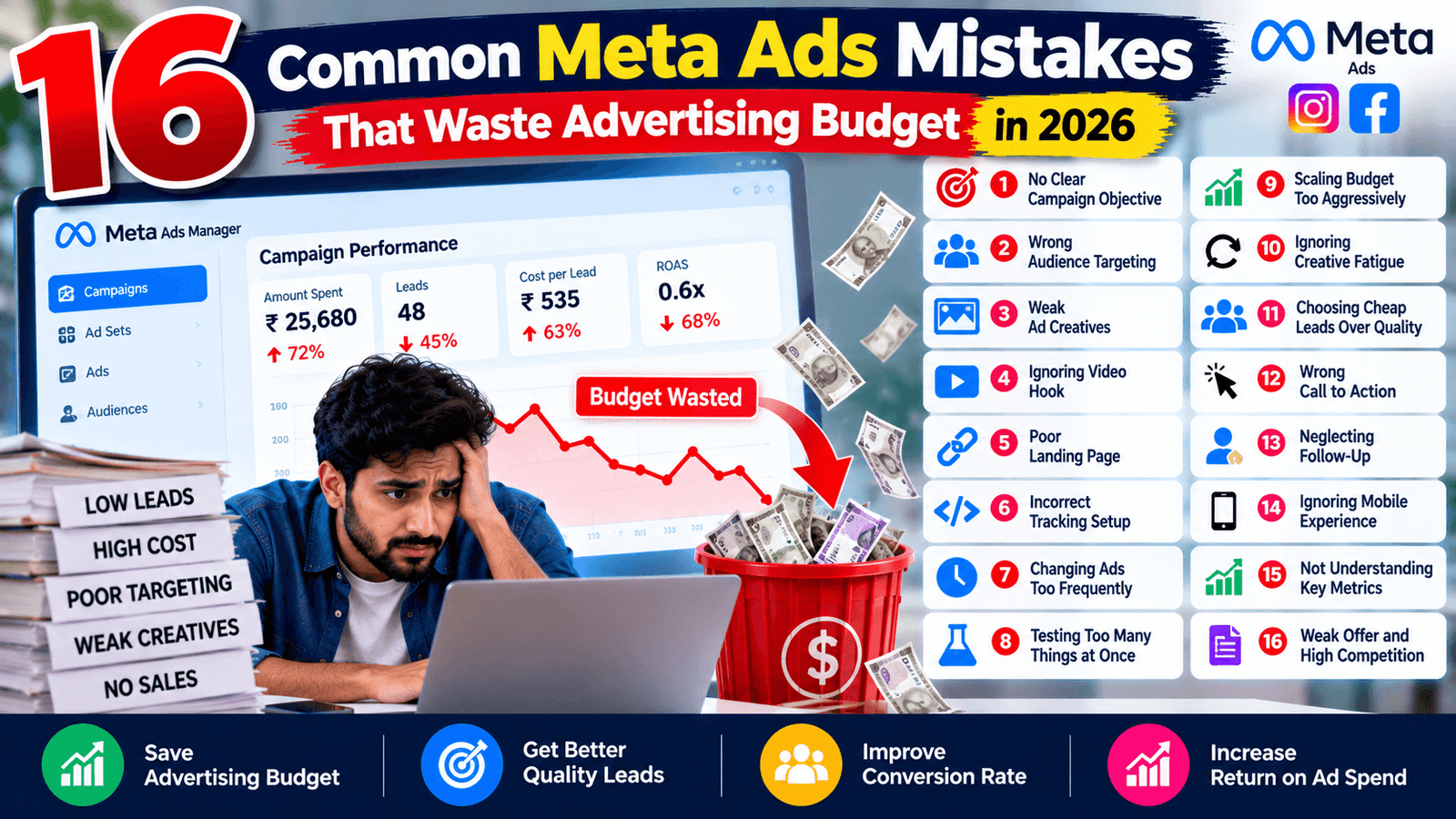
Common Meta Ads Mistakes That Waste Advertising Budget in 2026
Meta Ads can help businesses generate leads, sales, website traffic, and brand awareness through Facebook and Instagram. However, running ads without the right strategy can quickly waste your advertising budget.
Many businesses believe that increasing their ad spend will automatically bring better results. In reality, poor targeting, weak creatives, incorrect tracking, and ineffective campaign optimisation can prevent even well-funded campaigns from performing successfully.
In this guide, we’ll explore the most common Meta Ads mistakes that waste money and explain how to avoid them.
1. Running Ads Without a Clear Objective
One of the biggest mistakes is launching a campaign without defining what success looks like.
For example, a business that wants customer enquiries may choose a traffic campaign simply because website clicks appear inexpensive. But cheap clicks do not necessarily generate qualified leads.
How to avoid it:
- Define your primary business goal before launching.
- Choose a campaign objective aligned with that goal.
- Measure results using meaningful metrics, such as qualified leads, purchases, or cost per acquisition.
- Avoid judging campaign performance by likes and reach alone.
2. Targeting the Wrong Audience
Your advertisement may look excellent, but it will struggle if it reaches people who are unlikely to buy your product or service.
Overly broad targeting can sometimes waste money, while excessive audience restrictions can limit delivery and increase costs. The right approach depends on your offer, location, budget, and available conversion data.
How to avoid it:
- Define your ideal customer’s needs, location, and buying behaviour.
- Use relevant customer lists and website audiences when appropriate and permitted.
- Test broad targeting against suitable interest-based or other audience strategies.
- Exclude existing customers when your campaign is specifically intended to acquire new customers.
- Review lead quality instead of focusing only on lead volume.
3. Using Weak Ad Creatives
Your creative is often the first thing people notice. Generic images, unclear messages, poor-quality videos, and advertisements without a compelling benefit can cause people to scroll past.
How to avoid it:
- Use clear, attention-grabbing visuals.
- Communicate one main benefit.
- Show how your product or service solves a real problem.
- Test different images, videos, headlines, and opening hooks.
- Make sure the creative suits the Facebook or Instagram placement.
Do not assume that a professionally designed advertisement will always outperform a simple, authentic video. Test different formats with your target audience.
4. Ignoring the First Few Seconds of a Video
If a video advertisement takes too long to explain its purpose, viewers may lose interest before they see the offer.
How to avoid it:
- Introduce the problem or benefit immediately.
- Add readable on-screen text and captions.
- Keep the message focused.
- Demonstrate the product, service, or result early.
- Test different hooks while keeping the rest of the advertisement reasonably consistent.
5. Sending Traffic to a Poor Landing Page
A successful advertisement can still fail if the landing page is slow, confusing, or difficult to use on mobile devices.
For example, a user may click an ad for a course but leave because the page does not clearly explain the fees, course duration, location, or registration process.
How to avoid it:
- Ensure the landing page loads quickly.
- Keep the headline consistent with the advertisement.
- Display essential information clearly.
- Use a simple enquiry or checkout form.
- Make contact details and the call to action easy to find.
- Test the complete journey on a mobile phone.
6. Not Installing or Configuring Tracking Correctly
Without reliable tracking, advertisers may struggle to understand which campaigns generate valuable results.
Common problems include incorrect Pixel events, duplicate events, missing purchase values, and conversion actions that are not configured properly.
How to avoid it:
- Set up the Meta Pixel where relevant.
- Configure the correct conversion events.
- Use Conversions API when suitable for your website and technical setup.
- Check event quality and deduplication.
- Test events before scaling your campaign.
- Follow consent, privacy, and applicable data-protection requirements.
Remember that tracking systems can report different numbers because of attribution settings, consent limitations, and platform measurement differences.
7. Changing Campaigns Too Frequently
Some advertisers make changes whenever they see a few hours of poor performance. They repeatedly change budgets, audiences, creatives, and placements before enough data is available.
This makes it harder to identify what is actually working and may disrupt campaign delivery.
How to avoid it:
- Define a testing period and decision criteria before launch.
- Avoid unnecessary edits during the initial learning period.
- Make changes based on sufficient data and business outcomes.
- Change one major variable at a time when practical.
- Respond quickly to clear technical problems or abnormal spending.
There is no universal waiting period for every campaign. The appropriate evaluation window depends on the conversion cycle, budget, volume, and objective.
8. Testing Too Many Things at Once
If you change the audience, creative, headline, offer, and landing page simultaneously, you may not know which change improved or damaged performance.
How to avoid it:
- Start with a clear testing hypothesis.
- Test meaningful creative or audience variations.
- Keep other factors reasonably consistent.
- Record the results of each test.
- Use structured experiments when the budget and conversion volume allow.
Testing should help you learn, not simply produce more advertisements.
9. Scaling the Budget Too Aggressively
An advertisement that performs well with a small budget may not maintain the same results when spending increases substantially.
Rapid budget increases can change delivery patterns, and a larger audience may include people who are less likely to convert.
How to avoid it:
- Confirm that results are consistent enough to justify scaling.
- Check lead quality, conversion rates, and profit—not just volume.
- Increase spending in a controlled way.
- Monitor performance after meaningful changes.
- Keep sufficient budget for testing new creatives and offers.
Scale based on business performance, not excitement over a short-term result.
10. Ignoring Ad Frequency and Creative Fatigue
When the same audience repeatedly sees the same advertisement, engagement may decline and costs may rise. This is often called creative fatigue.
Frequency alone does not prove that an advertisement is failing, but it can be a useful warning signal when combined with other metrics.
How to avoid it:
- Monitor frequency alongside click-through rate and conversion performance.
- Refresh creatives when results begin to deteriorate.
- Test new messages, hooks, formats, and offers.
- Review audience size and campaign delivery.
- Avoid replacing a successful creative without evidence that it needs changing.
11. Choosing the Cheapest Leads Instead of Quality Leads
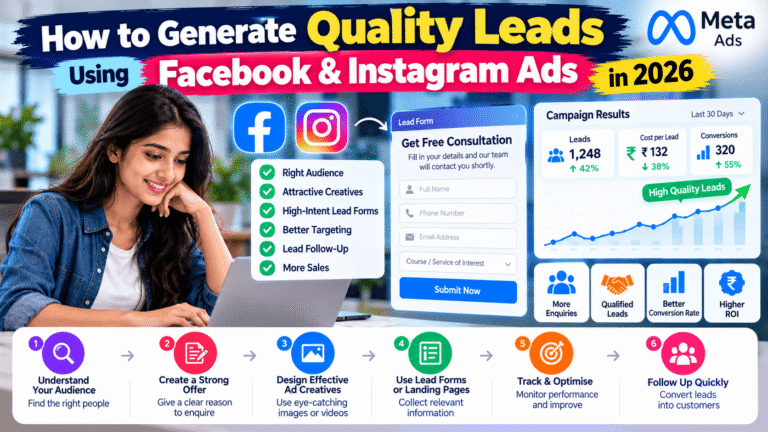
A campaign generating leads at ₹50 may appear better than one generating leads at ₹150. However, the cheaper campaign may produce unresponsive enquiries, while the more expensive campaign may bring customers who actually purchase.
How to avoid it:
- Track how many leads are contacted successfully.
- Measure qualified leads and appointments.
- Record sales and revenue generated.
- Share useful conversion-quality signals with Meta where technically appropriate and permitted.
- Calculate the cost per qualified lead and cost per customer.
For lead-generation businesses, the cheapest lead is not always the most profitable lead.
12. Using the Wrong Call to Action
An unclear or mismatched call to action can confuse potential customers. Asking someone to purchase immediately may be ineffective if they have only just discovered your brand.
How to avoid it:
- Match the call to action to the offer and audience.
- Use “Learn More” for relevant informational offers.
- Use “Sign Up” for registrations.
- Use “Book Now” when appointments are the goal.
- Use a suitable purchase action when customers are ready to buy.
Ensure that the destination fulfils the promise made in the advertisement.
13. Neglecting Follow-Up and Lead Management
Generating a lead is only one step in the sales process. If a business takes too long to respond, misses enquiries, or fails to follow up, the advertising budget may produce little revenue.
How to avoid it:
- Assign a clear owner for incoming leads.
- Respond promptly during business hours.
- Use a CRM to track enquiry status.
- Set reminders for follow-ups.
- Use appropriate WhatsApp or email automation with consent.
- Measure how many leads become paying customers.
Better follow-up can improve business results without requiring a larger advertising budget.
14. Ignoring Placement and Mobile Experience
Advertisements may appear across Facebook, Instagram, Reels, Stories, Feed, and other eligible placements. A creative that looks good in one placement may be cropped or difficult to read in another.
How to avoid it:
- Prepare suitable vertical, square, and landscape assets where needed.
- Check text positioning and safe areas.
- Preview your advertisements across relevant placements.
- Ensure the landing page works smoothly on mobile.
- Use automatic placements or manual placement controls according to your campaign needs and performance evidence.
15. Making Decisions Without Understanding the Metrics
Many advertisers look only at impressions, clicks, or cost per click. These numbers are useful, but they do not tell the whole story.
Here are some important metrics to monitor:
- CTR (Click-Through Rate): Indicates how frequently people click after seeing an ad.
- CPC (Cost Per Click): Shows the cost of generating clicks.
- CPL (Cost Per Lead): Measures the cost of generating a lead.
- Conversion Rate: Shows the percentage of visitors or leads completing a desired action.
- CPA (Cost Per Acquisition): Measures the cost of acquiring a customer or conversion.
- ROAS (Return on Ad Spend): Measures attributed revenue relative to advertising spend.
- Lead-to-Sale Rate: Indicates how effectively leads become customers.
Use these metrics together. A high CTR is not enough if the campaign generates no meaningful business outcomes.
16. Forgetting the Offer and Competition
Sometimes the problem is not the advertisement itself. The offer may be unclear, uncompetitive, or poorly suited to the target audience.
How to avoid it:
- Explain the value of your product or service.
- Make pricing and important terms transparent.
- Address common customer objections.
- Give customers a clear reason to take action.
- Compare your offer with relevant alternatives.
- Avoid making claims you cannot substantiate.
A better offer and a clear message can be more valuable than endless campaign adjustments.
A Practical Meta Ads Checklist Before Launch
Use this checklist before spending money on a new campaign.
- The campaign objective matches the business goal.
- The target audience and location are appropriate.
- The offer and call to action are clear.
- Creatives are readable and suitable for relevant placements.
- The landing page works on mobile.
- Forms and contact methods have been tested.
- Pixel and conversion events are configured where applicable.
- The budget and testing plan are defined.
- Lead follow-up and CRM processes are ready.
- Success metrics and evaluation criteria are established.
Final Thoughts
Meta Ads can be an effective growth channel, but results depend on more than selecting a budget and pressing the Publish button.
The biggest improvements often come from better targeting decisions, stronger creatives, accurate tracking, relevant landing pages, structured testing, and consistent lead follow-up.
Instead of increasing your budget whenever results are disappointing, identify the weakest part of your advertising funnel and improve it systematically.
At Hunar Digital, our practical approach to performance marketing focuses on campaign strategy, Meta Ads, Google Ads, analytics, AI tools, and marketing automation.
Want to learn performance marketing through practical training? Visit Hunar Digital to explore learning opportunities and build skills for real-world marketing campaigns.
Frequently Asked Questions
1. Why are my Meta Ads spending money but not generating leads?
Possible reasons include weak creatives, poor audience fit, an unclear offer, a slow landing page, tracking problems, or a complicated enquiry process. Review the complete customer journey before making major changes.
2. What is the biggest mistake in Meta Ads?
There is no single mistake that affects every campaign. However, failing to connect advertising decisions to real business outcomes—such as qualified leads, sales, and profit—is a common problem.
3. Should I use a traffic campaign or a leads campaign?
Choose based on your objective. If your primary goal is to generate enquiries, a lead-generation or suitable conversion-focused campaign is generally more aligned than optimising only for website visits.
4. How much should I spend on Meta Ads?
Your budget depends on your market, offer, conversion costs, sales process, and testing goals. Start with an amount your business can afford to test, then evaluate results using meaningful performance data.
5. How do I reduce the cost per lead?
Improve creative relevance, audience fit, offer clarity, form experience, and follow-up. Also measure lead quality, because reducing cost per lead without improving sales can create misleading results.
6. When should I stop a poorly performing Meta Ads campaign?
Use predefined evaluation criteria based on your acceptable acquisition cost, conversion volume, and sales cycle. Check tracking and technical issues first, and avoid making decisions from a tiny or unrepresentative sample.
7. Can AI help improve Meta Ads performance?
AI tools can assist with creative ideas, copy variations, reporting, audience insights, and workflow automation. However, results still depend on good strategy, reliable data, appropriate testing, and human review.