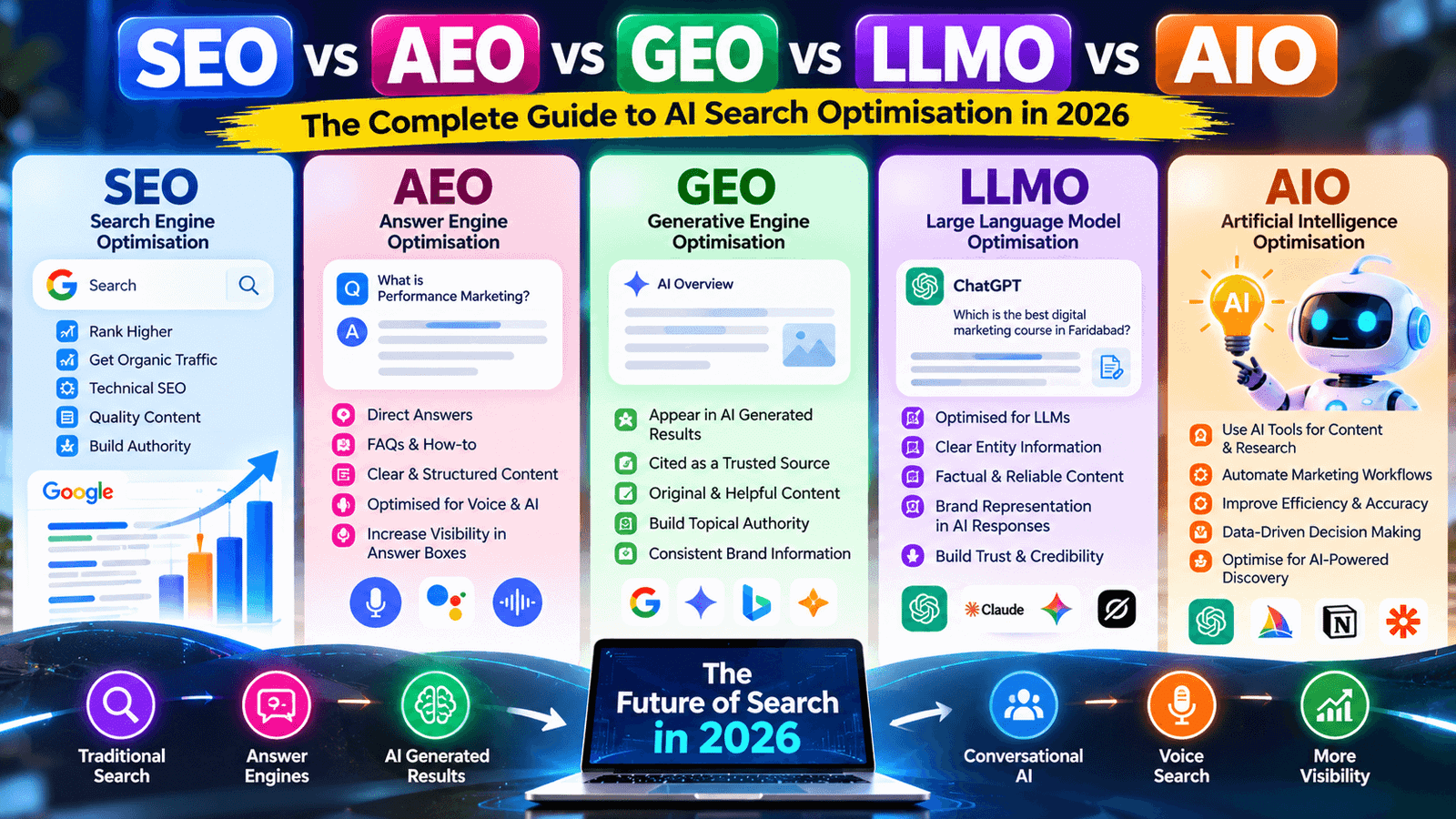
SEO vs AEO vs GEO vs LLMO vs AIO: The Complete Guide to AI Search Optimisation in 2026
Introduction: The Future of Search Is Changing
For years, businesses have focused on Search Engine Optimisation (SEO) to improve their visibility on Google and attract organic website traffic.
However, the way people discover information online is evolving.
Users increasingly ask questions through AI-powered assistants, conversational search interfaces, voice assistants, and platforms that generate answers rather than simply presenting a list of links.
Instead of searching only for “best digital marketing course,” a user might ask an AI assistant:
“Which digital marketing course should I choose if I want to learn Meta Ads, Google Ads, AI automation, and practical campaign management?”
This shift creates new opportunities and challenges for businesses, educators, marketers, and website owners.
Several terms are now used to describe different aspects of this changing search environment:
- SEO: Search Engine Optimisation
- AEO: Answer Engine Optimisation
- GEO: Generative Engine Optimisation
- LLMO: Large Language Model Optimisation
- AIO: Artificial Intelligence Optimisation, although the acronym has multiple meanings depending on context
These terms overlap, and they are not all universally standardised. They should not be treated as five completely separate disciplines.
The practical objective is to make your website useful, discoverable, understandable, credible, and eligible to appear in traditional search results and AI-generated answers.
In this guide, we will explain each concept, compare their differences, and explore how businesses can apply them in 2026.
1. What Is SEO? Search Engine Optimisation
Search Engine Optimisation is the process of improving a website’s visibility in unpaid search engine results.
SEO helps search engines discover, crawl, understand, and evaluate website content so that relevant pages can appear for suitable search queries.
Main objectives of SEO
- Improve organic search visibility.
- Attract relevant website visitors.
- Rank for useful keywords and search topics.
- Improve website structure and user experience.
- Build authority and trust within a subject area.
- Generate enquiries, sales, or other valuable conversions.
Important SEO activities
Keyword research: Understand what your target audience searches for and why.
On-page SEO: Improve page titles, headings, content structure, internal links, and relevant page elements.
Technical SEO: Help search engines crawl and index your website through sound architecture, appropriate canonicalisation, XML sitemaps, and other technical improvements.
Content quality: Publish accurate, useful, original information that satisfies search intent.
Off-page SEO: Earn relevant mentions, citations, and links that help establish your website’s credibility.
Performance and usability: Make pages accessible, mobile-friendly, and reasonably fast.
Example of SEO
Suppose Hunar Digital publishes an article titled:
“Performance Marketing Course in Faridabad: Syllabus, Skills and Career Opportunities.”
The article explains the course structure, practical projects, skills taught, and career options. It links to the relevant course page and provides clear information about the training programme.
With useful content, appropriate technical implementation, and genuine relevance to the search query, the article may attract organic traffic from people researching performance marketing courses.
SEO remains essential in 2026. AI-powered search experiences do not eliminate the need for accessible, trustworthy, well-structured website content.
2. What Is AEO? Answer Engine Optimisation
Answer Engine Optimisation focuses on making information easy for systems to identify and use when responding to specific questions.
These systems may include search features that display direct answers, conversational assistants, and other answer-oriented interfaces.
AEO places particular emphasis on answering user questions clearly and accurately.
Main objectives of AEO
- Provide direct answers to relevant questions.
- Improve the clarity and structure of website content.
- Address frequently asked questions.
- Support concise explanations, definitions, and step-by-step instructions.
- Help answer-oriented systems identify relevant information.
How to implement AEO
Answer questions directly. Begin important sections with a clear answer before expanding with examples and supporting details.
Use descriptive headings. Headings such as “What Is Performance Marketing?” communicate the purpose of a section more clearly than vague headings.
Create useful FAQ sections. Answer genuine questions that your audience asks, rather than adding repetitive keywords.
Use structured content. Organise information with meaningful headings, lists, tables, and appropriate HTML elements.
Provide reliable evidence. Support factual claims with trustworthy sources and explain uncertainty where relevant.
Use appropriate structured data. Implement relevant schema markup when it accurately describes the visible page content. Structured data does not guarantee that a page will appear in a particular search feature.
Example of AEO
A user asks:
“What is the difference between SEO and AEO?”
A useful answer would begin:
“SEO improves a website’s visibility in search engine results, while AEO focuses on making information easy for answer-oriented systems to identify and use in responses.”
The article can then provide examples, implementation guidance, and a comparison table.
This approach benefits readers because they can quickly understand the answer without navigating through unnecessary introductory text.
3. What Is GEO? Generative Engine Optimisation
Generative Engine Optimisation refers to improving the likelihood that a brand, website, or its information will be discovered, understood, cited, or represented accurately in AI-generated responses.
Generative search experiences may synthesise information from multiple sources rather than presenting only a conventional list of links.
Examples of AI-assisted search and answer experiences include Google AI Overviews, Google AI Mode, and conversational search products.
The precise way each platform retrieves, selects, cites, and presents information varies.
Main objectives of GEO
- Improve the visibility of useful information in generative search experiences.
- Establish clear and consistent brand information.
- Publish content that directly addresses relevant user questions.
- Support factual claims with reliable evidence.
- Increase the chances that relevant pages will be considered as sources.
- Make business information easy to verify.
How to improve GEO
Publish original information. Include real examples, documented research, first-hand expertise, useful comparisons, or original data when available.
Demonstrate experience and expertise. Explain who created the content, what relevant experience they have, and how claims were evaluated.
Maintain consistent business information. Ensure your business name, services, location, contact information, and course details are accurate across your website and relevant public profiles.
Use clear language. Explain concepts in a way that both humans and automated systems can understand.
Build legitimate authority. Earn relevant editorial mentions, professional references, and genuine links. Avoid buying artificial mentions or manufacturing citations.
Keep important pages accessible. Ensure the relevant content is available to users and permitted crawlers, subject to your access controls and robots policies.
Example of GEO
Imagine a student asks an AI search tool:
“Which institutes offer practical performance marketing training near Faridabad?”
A training provider may have a better chance of being considered when its website clearly explains its location, curriculum, teaching approach, contact details, and practical training offering.
However, clear content does not guarantee an AI recommendation. Results depend on the platform, the query, available sources, retrieval systems, location signals, and other factors.
Important: GEO is not a guaranteed ranking method. It is a developing optimisation approach, and there is no universal formula that guarantees inclusion in AI-generated answers.
4. What Is LLMO? Large Language Model Optimisation
Large Language Model Optimisation generally refers to practices intended to improve how a brand, its content, or its information is understood and represented in large language model-based systems.
LLMs are AI models trained to process and generate language. Depending on the product, an LLM-based assistant may answer from its trained model, retrieve current information from external sources, use connected tools, or combine these methods.
This distinction matters because a model’s stored knowledge and a search-enabled assistant’s retrieved information are not the same thing.
Main objectives of LLMO
- Make brand and product information clear and consistent.
- Publish factual, well-organised content.
- Reduce ambiguity about services, products, people, and organisations.
- Improve the availability of reliable public information.
- Support accurate representation of the brand when relevant information is retrieved or used.
How to approach LLMO
Create authoritative website pages. Maintain clear About, Services, Contact, author, and product or course pages.
Explain entities consistently. Use the same accurate business name and descriptions across your website and relevant profiles.
Publish specific, useful content. Detailed explanations, documented processes, and original research are more valuable than generic articles created only to repeat keywords.
Cite credible sources. Reference reliable sources when making important factual claims.
Use structured data where appropriate. Schema markup can help systems interpret supported information, but it does not force an LLM to remember or recommend a business.
Monitor how your brand is represented. Test relevant questions across different AI products, record incorrect claims, and improve the underlying public information where possible.
Example of LLMO
Suppose a user asks an AI assistant:
“What services does Hunar Digital offer?”
A clear website with accurate service pages, course descriptions, contact details, and consistent public business information gives information-retrieval systems a stronger factual basis for describing the business.
It does not guarantee that every AI model will know the business, retrieve its website, or recommend it.
LLMO is a developing term, and practices associated with it overlap substantially with SEO, GEO, content strategy, digital PR, and knowledge representation.
5. What Is AIO? Artificial Intelligence Optimisation
The term AIO is particularly ambiguous.
In this context, AIO means Artificial Intelligence Optimisation: the broad practice of improving digital content, systems, or workflows for AI-related discovery and use.
However, AIO can also mean AI Overviews in some search discussions, or AI optimisation in other technical and marketing contexts. Always clarify the intended meaning when using this acronym.
Unlike GEO or LLMO, AIO is not a universally agreed-upon, standalone search optimisation discipline.
What AIO can involve in digital marketing
- Using AI tools to support content research and editing.
- Improving information structure and factual consistency.
- Using AI to analyse customer questions and search intent.
- Automating content workflows and reporting.
- Evaluating how AI search products represent a business.
- Applying human review to improve accuracy and usefulness.
Example of AIO
A digital marketing team might use AI tools to analyse customer feedback, group recurring questions, draft an article outline, and identify gaps in existing content.
The team then verifies facts, adds original insights, edits the article, and measures its performance.
This is a practical AI-assisted optimisation workflow. It is different from simply publishing large quantities of unreviewed AI-generated content.
Using AI to create content does not automatically improve rankings or AI search visibility. Content quality, accuracy, usefulness, originality, and the applicable platform guidelines remain important.
6. SEO vs AEO vs GEO vs LLMO vs AIO: Key Differences
| Factor | SEO | AEO | GEO | LLMO | AIO |
|---|---|---|---|---|---|
| Full form | Search Engine Optimisation | Answer Engine Optimisation | Generative Engine Optimisation | Large Language Model Optimisation | Artificial Intelligence Optimisation |
| Primary focus | Organic search visibility | Clear answers to questions | Visibility in generative responses | How LLM-based systems understand or represent information | Broad AI-related optimisation |
| Typical target | Search engine results | Answer-oriented experiences | AI-generated search and answers | LLM-based products and information systems | AI-supported content and workflows |
| Key activities | Technical SEO, content, links | Direct answers, FAQs, structured content | Original evidence, clear content, credible sources | Consistent facts, entity clarity, reliable information | AI-assisted analysis, content, workflows |
| Measurement | Rankings, impressions, clicks, conversions | Relevant answer visibility and referral traffic where measurable | Citations, mentions, referrals and qualified traffic where measurable | Accurate representation and relevant mentions where measurable | Workflow quality, accuracy, efficiency and business outcomes |
These are practical distinctions, not rigid technical boundaries. Their activities overlap, and platforms do not necessarily use these labels internally.
7. How Do These Five Approaches Work Together?
The strongest approach is not to run five disconnected optimisation campaigns.
Instead, build a reliable content and website foundation that supports traditional search, question answering, generative search, and AI-assisted workflows.
Consider a business publishing an article about performance marketing courses.
Step 1: SEO foundation
Research the audience’s needs, create a useful page, optimise its title and headings, provide internal links, and ensure the page can be crawled and indexed appropriately.
Step 2: AEO improvements
Answer common questions directly, explain key concepts, and include useful comparisons and FAQs.
Step 3: GEO improvements
Add original examples, credible references, accurate details, and information that can help a reader evaluate the subject.
Step 4: LLMO considerations
Ensure the business identity, author information, services, course details, and related public facts are consistent and unambiguous.
Step 5: AIO workflow
Use AI tools to support research, outline development, editing, content audits, and reporting, with human verification throughout.
The result is one high-quality resource designed for multiple discovery environments rather than five repetitive versions of the same article.
8. Practical Strategy: How to Optimise Your Website for AI Search in 2026
Here is a practical implementation plan for businesses and website owners.
Step 1: Audit your website
Review indexability, page structure, internal links, mobile usability, loading performance, and important business information.
Resolve technical problems before creating large quantities of new content.
Step 2: Understand real customer questions
Use customer enquiries, sales conversations, search query data, site search, and relevant audience research to identify the questions people actually ask.
Prioritise questions that align with your expertise and services.
Step 3: Create useful topic clusters
Develop interconnected articles around a clear subject.
For example, a performance marketing cluster might contain:
- What is performance marketing?
- Digital marketing vs performance marketing.
- Meta Ads vs Google Ads.
- How to calculate CPL and ROAS.
- Performance marketing careers and skills.
- How to set up conversion tracking.
Link these articles naturally to each other and to the relevant course or service page.
Step 4: Improve factual accuracy and trust
Identify the author, explain relevant experience, support factual claims, update outdated information, and correct inconsistencies.
Avoid invented statistics, fabricated testimonials, and unsupported claims about results.
Step 5: Use structured data correctly
Consider relevant schema types such as Article, Organization, Person, BreadcrumbList, and Course where supported and appropriate.
Structured data must accurately reflect visible page content and comply with the relevant platform’s requirements. It is not a shortcut to guaranteed rankings or AI citations.
Step 6: Review crawler access and technical settings
Check your robots.txt file, sitemap, canonical tags, and page access rules.
Some AI services have separate crawlers for search retrieval and model training. Their purposes and controls differ. Review each provider’s current documentation before changing crawler permissions.
Do not block useful search crawlers without understanding the consequences, and do not assume that allowing a crawler guarantees inclusion.
Step 7: Measure the results
Monitor:
- Organic impressions, clicks, rankings, and conversions.
- Relevant referral traffic from AI services where identifiable.
- Qualified leads and enquiries.
- Brand mentions and citations in selected AI search experiences.
- Accuracy of brand and business information in AI responses.
- Engagement and conversion performance of published content.
AI citations and mentions can be difficult to measure comprehensively. Test a consistent set of relevant questions periodically, record the source and result, and treat the findings as directional rather than a complete measure of visibility.
9. Common AI Search Optimisation Mistakes to Avoid
Businesses often misunderstand these emerging terms and invest in tactics that produce little value.
Mistake 1: Assuming SEO Is Dead
Traditional SEO remains important for discoverability, indexing, website quality, and organic traffic. AI search adds new discovery experiences rather than making all existing SEO practices irrelevant.
Mistake 2: Publishing Hundreds of AI-Generated Articles
Producing large amounts of repetitive, low-value content can waste resources and create search quality risks. AI should support useful content creation, not replace original thinking and factual verification.
Mistake 3: Treating GEO as a Guaranteed Ranking Formula
No legitimate method can guarantee that an AI assistant will cite, mention, or recommend a particular website.
Mistake 4: Overusing Keywords and Acronyms
Repeating SEO, AEO, GEO, LLMO, and AIO unnaturally does not make content more authoritative. Explain concepts because they help readers, not merely because they are trending terms.
Mistake 5: Ignoring Business Fundamentals
Search visibility is not the same as commercial success. A website still needs a credible offer, useful services, clear contact details, good customer experience, and effective conversion processes.
Mistake 6: Confusing AI Content Creation With AI Search Optimisation
Using AI to write a blog is a production method. Improving a website’s discoverability and representation in AI search experiences is a different objective, even though the activities may overlap.
10. The Future of SEO, AEO, GEO, LLMO and AIO
The search environment is likely to continue evolving as AI-assisted answers, conversational interfaces, multimodal search, and personalised discovery become more prominent.
However, the exact future of each acronym is uncertain. Industry terminology is still developing, and platforms may introduce new features without adopting these labels.
The more durable priorities are:
- Useful and original content.
- Accurate, verifiable information.
- Strong technical foundations.
- Clear website structure and entity information.
- Demonstrable expertise and credible sources.
- Positive user experience.
- Meaningful measurement and business outcomes.
- Responsible use of AI and automation.
Businesses that focus on these fundamentals are better positioned to adapt as search interfaces and retrieval systems change.
Frequently Asked Questions
1. What is the difference between SEO and GEO?
SEO focuses on improving visibility in traditional organic search results and related search experiences. GEO focuses on improving the likelihood that relevant information will be surfaced, cited, or represented in generative AI responses. The two approaches overlap significantly.
2. Is AEO replacing SEO?
No. AEO complements SEO by emphasising clear, direct answers to user questions. Search engine accessibility, useful content, and technical quality remain important.
3. What does LLMO mean?
LLMO stands for Large Language Model Optimisation. It generally refers to practices intended to improve how a brand or its information is understood and represented in LLM-based systems.
4. What does AIO mean in digital marketing?
AIO can mean Artificial Intelligence Optimisation in this context, but the acronym has several meanings. It is important to define the term clearly rather than assume every reader uses it in the same way.
5. Can AI search engines use my website content?
Depending on the product, an AI service may retrieve publicly accessible web pages, use indexed information, rely on other sources, or combine different retrieval methods. Inclusion is not guaranteed and depends on the service’s systems and policies.
6. Does schema markup improve GEO?
Accurate structured data can help supported systems interpret information about a page or entity. It does not guarantee that a page will be cited in AI-generated responses.
7. How can a small business improve AI search visibility?
Start with an accurate website, clear service pages, helpful answers to customer questions, credible business information, relevant local profiles, and useful content. Track real enquiries and relevant referral traffic rather than relying on speculative visibility scores.
8. Should businesses hire an SEO expert or an AI search optimisation expert?
Start by evaluating the actual work required. A strong SEO professional with technical, content, analytics, and AI search knowledge may be more useful than a specialist selling an unproven acronym-based service. Ask for a clear methodology, realistic expectations, and measurable deliverables.
Conclusion
SEO, AEO, GEO, LLMO, and AIO describe overlapping ways of improving how information is created, discovered, understood, and used across traditional search engines and AI-powered experiences.
SEO provides the technical and content foundation. AEO emphasises clear answers. GEO focuses on generative search visibility. LLMO considers how information is represented in large language model-based systems. AIO can describe broader AI-related optimisation practices.
The most effective strategy is to avoid treating these acronyms as five unrelated ranking systems.
Instead, build a technically sound website, publish useful and original information, maintain accurate business details, support claims with evidence, use AI responsibly, and measure meaningful business outcomes.
**In 2026, the objective is not merely to rank on Google or appear in an AI answer. It is to make your business a credible, relevant, and useful source of information wherever your audience searches