
Scope of Performance Marketing in 2026: Career Opportunities, Salary, Skills & Future Growth
The digital economy is changing how businesses attract customers, generate leads, and increase sales. From startups and local businesses to established companies and e-commerce brands, organisations are investing in digital advertising to reach their target audiences and measure business results.
This shift has increased the importance of performance marketing, a data-driven approach to digital marketing that focuses on measurable outcomes such as leads, sales, app installations, website conversions, and customer acquisition.
Unlike traditional advertising, performance marketing allows businesses to track campaign performance through metrics such as cost per lead (CPL), cost per acquisition (CPA), return on ad spend (ROAS), and conversion rate.
In 2026, the combination of artificial intelligence (AI), marketing automation, advanced analytics, and advertising platforms is creating new opportunities for skilled performance marketers.
Whether you are a student, job seeker, entrepreneur, freelancer, or working professional, learning performance marketing can help you explore a wide range of career and business opportunities.
What Is Performance Marketing?
Performance marketing is a digital marketing strategy in which campaigns are planned, executed, and optimised using measurable performance indicators.
Businesses use different advertising channels to reach potential customers and evaluate whether their marketing expenditure is producing meaningful results.
Common performance marketing channels include:
- Meta Ads: Facebook and Instagram advertising for lead generation, sales, and brand discovery.
- Google Ads: Search, Display, Shopping, and other advertising campaigns.
- YouTube Advertising: Video campaigns designed to generate awareness, leads, and conversions.
- Affiliate Marketing: Partnerships where publishers promote products or services in exchange for commission.
- E-commerce Advertising: Campaigns designed to increase online sales and improve customer acquisition.
- Remarketing: Re-engaging eligible audiences who previously interacted with a business.
- Marketing Automation: Using CRM systems, automated workflows, and AI tools to manage leads and improve follow-up.
The objective is not simply to generate clicks or impressions. It is to understand which activities contribute to business growth and improve results through continuous testing and optimisation.
Why Is Performance Marketing Important in 2026?
Several developments are shaping the performance marketing industry in 2026.
1. Businesses Want Measurable Results
Companies increasingly want to understand how their advertising budgets contribute to leads, sales, revenue, and profit.
Performance marketers help businesses measure campaign effectiveness and make better decisions about budget allocation.
2. AI Is Changing Digital Advertising
AI-powered tools can support audience analysis, creative development, campaign optimisation, reporting, and customer segmentation.
However, AI does not eliminate the need for human judgement. Marketers still need to understand customer behaviour, business economics, creative strategy, conversion tracking, and campaign profitability.
3. Competition in Digital Advertising Is Increasing
As more businesses advertise online, simply launching an advertising campaign is no longer enough.
Companies need marketers who can identify the right audience, create effective advertisements, build high-converting landing pages, analyse results, and improve lead quality.
4. Local Businesses Are Investing in Digital Growth
Education institutes, real estate companies, clinics, coaching centres, restaurants, service providers, and other local businesses can use digital campaigns to generate enquiries and attract customers.
This creates opportunities for performance marketers who understand local targeting, lead management, WhatsApp communication, CRM systems, and conversion optimisation.
5. Marketing Automation Is Becoming More Valuable
Generating leads is only one part of the customer acquisition process. Businesses also need systems to follow up with enquiries, qualify prospects, schedule appointments, and convert leads into paying customers.
Professionals who combine paid advertising with CRM integration and automation can offer more complete marketing solutions.
Career Opportunities in Performance Marketing
Performance marketing offers several potential career paths, depending on your technical skills, experience, and ability to produce business results.
| Job Role | Primary Responsibility |
|---|---|
| Performance Marketing Executive | Manage advertising campaigns and monitor results |
| Meta Ads Specialist | Plan and optimise Facebook and Instagram campaigns |
| Google Ads Specialist | Manage search and other Google advertising campaigns |
| Performance Marketing Manager | Lead strategy, budgets, testing, and campaign performance |
| Marketing Analytics Specialist | Analyse data, conversions, attribution, and campaign reports |
| Conversion Rate Optimisation Specialist | Improve landing pages and conversion rates |
| Marketing Automation Specialist | Build automated workflows and CRM integrations |
| Growth Marketing Specialist | Improve customer acquisition, activation, and retention |
| Freelance Performance Marketer | Manage advertising campaigns for multiple clients |
| Digital Marketing Consultant | Develop marketing strategies for businesses |
Entry-level professionals may begin with campaign execution and reporting. With experience, they can move towards strategy, analytics, budget management, growth marketing, or leadership roles.
Performance Marketing Salary in India
Salary depends on practical skills, location, company size, industry, communication ability, and demonstrated campaign results.
The following figures are illustrative planning ranges, not verified 2026 market averages or guaranteed salary offers.
| Experience Level | Indicative Annual Salary |
|---|---|
| Fresher / Trainee | ₹1.8–3.6 lakh |
| 1–2 Years | ₹3–6 lakh |
| 3–5 Years | ₹6–12 lakh |
| Senior Specialist / Manager | ₹10–20 lakh or more |
These ranges can vary considerably. Some professionals earn less, while specialists with strong analytical skills, substantial advertising budgets, and proven commercial results may earn more.
Candidates who can demonstrate real campaign experience, conversion tracking, reporting, landing-page optimisation, and lead-generation results may have an advantage over candidates with only theoretical knowledge.
Important: Completing a course does not guarantee a job or a particular salary. Practical ability and evidence of results matter.
Essential Skills Required to Become a Performance Marketer
To build a career in performance marketing, focus on developing the following skills.
1. Digital Marketing Fundamentals
Understand customer journeys, target audiences, marketing funnels, campaign objectives, and the difference between awareness, consideration, and conversion campaigns.
2. Meta Ads and Google Ads
Learn campaign structures, budgets, bidding, audience strategy, keyword research, ad creatives, conversion objectives, and optimisation techniques.
3. Tracking and Analytics
Understand Meta Pixel, Conversions API concepts, Google Analytics 4 (GA4), Google Tag Manager, UTM parameters, and conversion tracking.
Tracking implementation must respect applicable privacy requirements, consent choices, and platform policies.
4. Data Analysis
Learn to interpret click-through rate (CTR), cost per click (CPC), cost per lead (CPL), conversion rate, customer acquisition cost (CAC), and return on ad spend (ROAS).
A good marketer understands not only what happened but also why it happened and what should be changed next.
5. Ad Copywriting and Creative Strategy
Develop the ability to create compelling headlines, persuasive ad copy, effective calls to action, and creative concepts that address customer needs.
6. Landing Pages and Conversion Optimisation
Learn how page speed, mobile usability, forms, messaging, trust signals, and page structure affect conversions.
7. AI Tools and Marketing Automation
Use AI responsibly for research, content ideation, creative variations, reporting assistance, and workflow development. Learn how CRM systems and automation tools can improve follow-up and lead management.
8. Business and Financial Understanding
Understand the relationship between advertising expenditure, gross margin, sales conversion rate, customer lifetime value, and profitability.
A campaign that produces inexpensive leads is not necessarily successful if those leads do not convert into customers.
How AI Is Changing the Future of Performance Marketing
Artificial intelligence is becoming an important part of campaign management, creative production, data analysis, and marketing automation.
In 2026, marketers can use AI to support tasks such as:
- Generating and testing advertising copy variations.
- Developing creative concepts for different audience segments.
- Summarising campaign reports and identifying possible performance patterns.
- Supporting customer segmentation and lead qualification.
- Automating repetitive reporting and marketing workflows.
- Analysing landing-page content and suggesting improvements.
- Connecting marketing tools with CRM systems through automation platforms and APIs.
However, AI-generated recommendations should not be accepted blindly. Incorrect tracking, poor-quality data, weak offers, unsuitable targeting, and ineffective landing pages can still produce disappointing results.
The future belongs to marketers who combine AI tools with analytical thinking, creativity, technical knowledge, and commercial understanding.
Is Performance Marketing a Good Career for Freshers?
Performance marketing can be a promising career option for freshers who enjoy technology, problem-solving, business growth, and data-driven decision-making.
A degree in marketing may be useful, but employers can also value practical skills and demonstrable project experience.
Freshers should focus on the following:
- Learn the fundamentals of digital marketing.
- Practise building Meta Ads and Google Ads campaign structures.
- Understand conversion tracking and analytics.
- Create sample campaigns for realistic business scenarios.
- Build landing pages and practise lead-generation workflows.
- Prepare reports explaining campaign performance and optimisation decisions.
- Develop a portfolio containing case studies and project documentation.
Where possible, gain supervised experience with real campaigns. Never present simulated results as genuine client results or claim responsibility for campaign performance you did not manage.
Freelancing and Business Opportunities in Performance Marketing
Performance marketing can also provide a foundation for independent work and agency services.
Freelancers and agencies may offer services such as:
- Meta Ads management.
- Google Ads management.
- Lead-generation campaigns.
- Landing-page development and optimisation.
- Conversion tracking and analytics setup.
- CRM integration and lead automation.
- E-commerce advertising.
- Local business marketing.
- Performance reporting and consulting.
A freelancer might specialise in a specific industry, such as education, healthcare, real estate, or professional services.
Specialisation can help a marketer understand industry-specific customer behaviour and develop repeatable campaign processes.
However, freelancing is not automatically profitable. Finding clients, retaining them, managing expectations, reporting accurately, and delivering measurable results require time and consistent effort.
Businesses should agree on campaign objectives, service fees, advertising budgets, reporting frequency, and responsibilities before work begins.
How to Start Learning Performance Marketing
A structured learning plan can help beginners develop skills progressively.
Month 1: Foundations and Advertising Platforms
Learn digital marketing principles, customer research, Meta Ads, Google Ads fundamentals, campaign structures, copywriting, and creative development.
Month 2: Tracking, Analytics and Optimisation
Practise conversion tracking, GA4, Google Tag Manager, campaign reporting, landing-page analysis, A/B testing, and budget optimisation.
Month 3: AI, Automation and Practical Projects
Explore AI-assisted workflows, CRM integration, lead follow-up automation, reporting dashboards, and campaign case studies.
Month 4: Internship or Supervised Project Experience
Where available, work on practical projects, document your decisions, evaluate campaign results, and build a portfolio.
The actual time required depends on your starting knowledge, practice hours, access to advertising accounts, and project complexity. Some advanced technical skills require additional learning beyond this roadmap.
Why Practical Training Matters
Watching tutorials alone does not prepare every learner for the demands of a performance marketing role.
Practical training should include campaign planning, ad account navigation, creative testing, tracking implementation, analytics, reporting, and optimisation exercises.
A strong training programme should also teach learners how to evaluate lead quality, understand business profitability, communicate with clients, and explain campaign decisions.
When comparing courses, check the syllabus, trainer experience, practical assignments, internship terms, project access, and placement support. Ask whether advertising spend is included or charged separately.
Learn Performance Marketing with Hunar Digital
Hunar Digital offers an opportunity for aspiring marketers to explore digital advertising, performance marketing, AI-assisted marketing, analytics, and automation through structured learning.
The practical focus should be on helping learners understand how businesses attract customers, measure campaign results, improve conversions, and build marketing systems.
Whether you want to start a career, improve your business marketing, or explore freelancing, choose a learning programme that prioritises hands-on practice over theory alone.
Interested in learning performance marketing?
Explore the courses available at Hunar Digital and choose a programme aligned with your career goals.
Website: https://hunardigital.com/
Frequently Asked Questions (FAQs)
1. What is the scope of performance marketing in 2026?
Performance marketing offers opportunities across paid advertising, lead generation, e-commerce, marketing analytics, growth marketing, conversion optimisation, and automation. Career prospects depend on business demand and the candidate’s practical skills.
2. Is performance marketing in demand?
Many businesses use paid digital advertising and measurable marketing campaigns. Demand for individual roles varies by industry, location, company budgets, and the ability to demonstrate results.
3. Can a fresher learn performance marketing?
Yes. A beginner can start with digital marketing fundamentals, Meta Ads, Google Ads, analytics, and practical projects. Real-world campaign experience can strengthen a job application.
4. What is the salary of a performance marketer in India?
Compensation varies by experience, location, employer, and technical expertise. Entry-level salaries may be lower than those of experienced specialists and managers. Candidates should compare current job listings rather than rely on a single salary estimate.
5. Will AI replace performance marketers?
AI will automate or simplify some tasks, but businesses still need professionals who can evaluate strategy, understand customers, interpret data, manage budgets, and connect marketing activities to revenue.
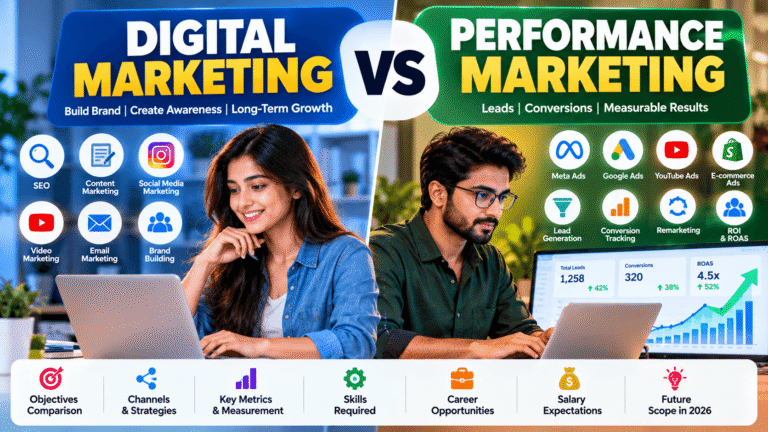
6. Is performance marketing better than general digital marketing?
They serve overlapping but different purposes. General digital marketing may include SEO, content, social media, and brand development. Performance marketing focuses more heavily on measurable outcomes and campaign economics. Both skill sets can complement each other.
7. Can I start a performance marketing agency?
Yes, but success requires more than advertising knowledge. You need a clear service offering, client acquisition strategy, reliable reporting, realistic expectations, and the ability to deliver commercially meaningful results.
Conclusion
The scope of performance marketing in 2026 extends beyond managing advertisements. It combines digital advertising, AI, analytics, creative strategy, conversion optimisation, and marketing automation.
For students and professionals, the strongest approach is to develop practical skills, work on credible projects, understand business economics, and keep learning as advertising platforms evolve.
For businesses, performance marketing can support more informed decisions about customer acquisition and marketing expenditure when campaigns are tracked properly and evaluated against meaningful business outcomes.
Start with the fundamentals, practise consistently, and build evidence of your skills. That is a more reliable path towards a performance marketing career than depending on certificates or salary promises alone.