
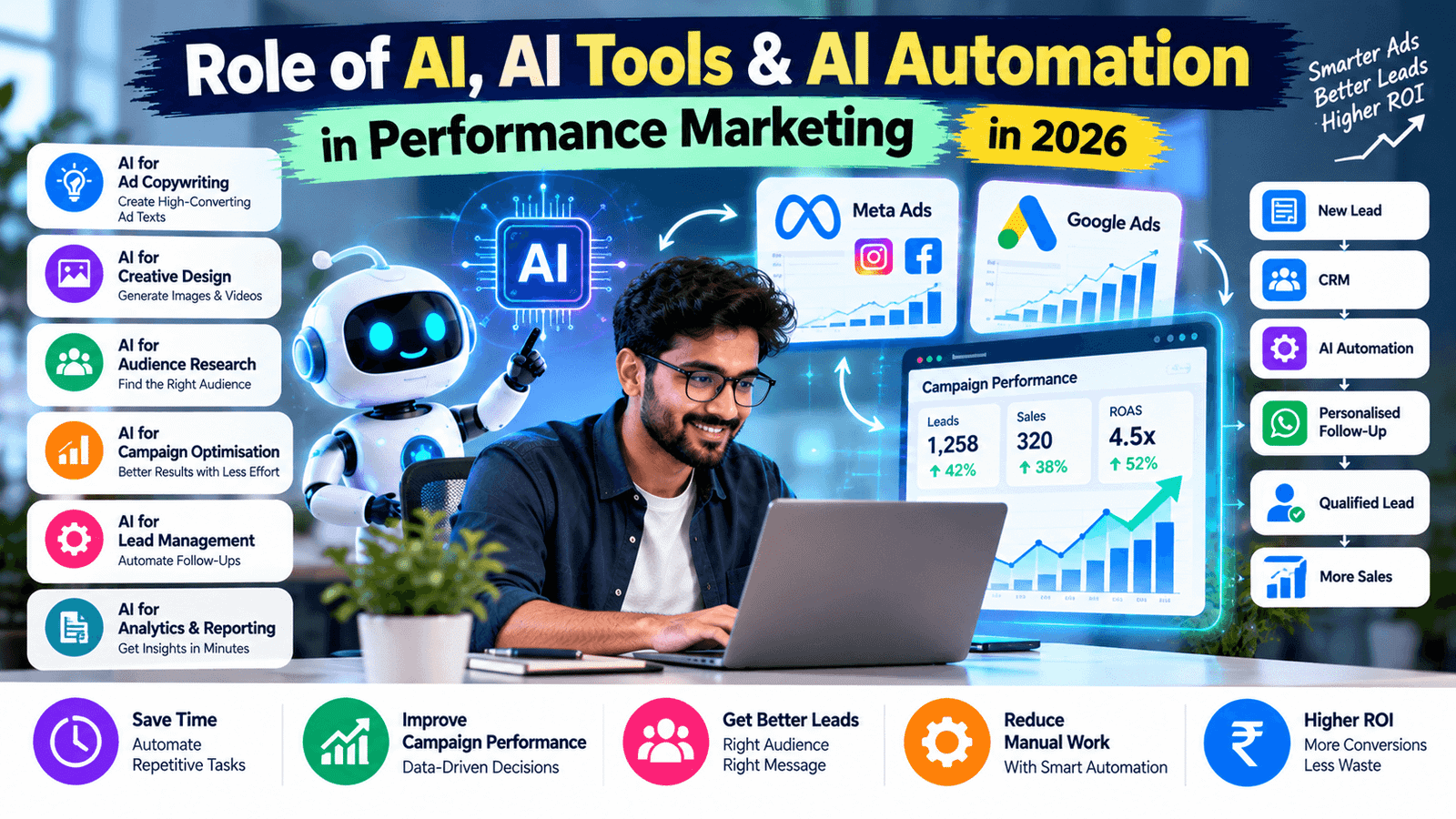
Role of AI, AI Tools & AI Automation in Performance Marketing in 2026
Introduction
Artificial Intelligence (AI) is changing the way businesses advertise, generate leads, and increase sales. In 2026, performance marketers are using AI-powered tools and automation to improve campaign efficiency, analyse data, create advertisements, and manage customer enquiries.
Traditional marketing often requires considerable manual effort to create content, analyse campaign results, and follow up with potential customers. AI can help simplify these tasks and allow marketers to focus more on strategy and business growth.
However, AI alone cannot guarantee successful marketing campaigns. The best results come from combining AI technology with human creativity, marketing knowledge, accurate data, and practical experience.
In this article, we will explore the role of AI, popular AI tools, marketing automation, and their future in performance marketing.
1. What Is AI in Performance Marketing?
AI in performance marketing means using artificial intelligence to improve advertising campaigns and measurable business outcomes.
AI can help marketers analyse campaign performance, develop advertising content, understand customer behaviour, identify patterns, and improve reporting.
Its major applications include:
- Advertising campaign optimisation
- AI-powered ad copywriting
- Creative and video generation
- Audience research
- Lead qualification
- Marketing analytics and reporting
- Customer segmentation
- Automated follow-ups
For example, a business running Facebook and Instagram advertisements can use AI tools to create different ad headlines, analyse campaign results, and identify opportunities for improvement.
2. Difference Between AI, AI Tools and AI Automation
Artificial Intelligence (AI): Technology that performs tasks such as analysing information, recognising patterns, and generating content.
AI Tools: Applications that use AI to help marketers complete specific tasks, such as writing advertisements, creating graphics, or analysing reports.
AI Automation: Systems that connect applications and workflows to perform repetitive tasks with less manual intervention.
For example, ChatGPT can help write an advertising message, while an automation platform can connect an enquiry form to a CRM and trigger an appropriate follow-up process.
Together, these technologies can make marketing operations more efficient.
3. Best AI Tools for Performance Marketing
ChatGPT
Useful for advertising copywriting, campaign ideas, marketing strategies, content planning, and report summaries.
Google Gemini
Useful for research, brainstorming, content assistance, and productivity tasks across compatible Google products.
Canva AI
Useful for designing advertising creatives, social media graphics, presentations, and marketing visuals.
Meta Ads Manager
Provides advertising management and automated campaign optimisation features for Facebook and Instagram advertising.
Google Ads
Uses machine learning in supported advertising features to help with campaign delivery, bidding, and optimisation.
Make
Connects compatible applications to automate lead management, notifications, reporting, and other repetitive marketing tasks.
Zapier
Helps connect different business applications and automate workflows without requiring extensive programming knowledge.
HubSpot
Provides CRM, lead management, sales pipeline, and marketing automation capabilities.
The right tools depend on your marketing goals, budget, integrations, and business requirements.
4. How AI Improves Performance Marketing
AI-Powered Advertising
Advertising platforms use machine learning to support campaign delivery, bidding, and optimisation. Marketers can use these features to improve campaign management while monitoring actual business results.
AI Copywriting
AI helps generate advertising headlines, descriptions, calls to action, and different messaging variations for testing.
AI Creative Generation
AI-powered design and video tools can help marketers produce advertising graphics, video concepts, captions, and creative variations more efficiently.
Audience Research
AI can help analyse customer feedback, identify common questions, and understand customer preferences.
Performance Analysis
AI tools can summarise campaign data and identify changes in important metrics such as cost per lead, conversion rate, and return on ad spend.
Lead Management
AI can help classify enquiries, summarise conversations, and support sales teams in prioritising follow-ups.
AI-generated insights should always be checked against reliable data before important business decisions are made.
5. What Is Marketing Automation?
Marketing automation uses software and predefined workflows to complete repetitive marketing tasks automatically.
For example, when someone enquires about a digital marketing course, an automated workflow might:
- Collect the enquiry through a website form.
- Store the details in a CRM.
- Assign the enquiry to a counsellor.
- Send an appropriate confirmation message.
- Schedule a follow-up reminder.
- Track the enquiry until it becomes a customer or is closed.
AI can enhance this process by helping categorise enquiries or draft personalised responses.
Automation should be tested carefully to prevent duplicate records, incorrect messages, and missed enquiries. Customer data and communications must also be handled responsibly.
6. Practical Example of AI in Performance Marketing
Imagine a training institute spends ₹30,000 on advertising in one month.
The campaign generates 150 enquiries, and 30 people enrol.
| Metric | Result |
|---|---|
| Advertising Budget | ₹30,000 |
| Total Enquiries | 150 |
| Cost Per Lead | ₹200 |
| Paid Admissions | 30 |
| Advertising Cost Per Admission | ₹1,000 |
AI tools can help the institute analyse enquiries, prepare reports, identify unanswered leads, and draft follow-up messages.
Automation can help the team respond faster and track each enquiry through the sales process.
These tools may improve efficiency, but they cannot guarantee more admissions or lower advertising costs. Results depend on lead quality, the course offering, sales follow-up, and campaign effectiveness.
7. Benefits of AI and Automation in Performance Marketing
- Saves time on repetitive tasks.
- Helps generate advertising ideas faster.
- Supports campaign analysis and reporting.
- Improves lead organisation and follow-up.
- Helps marketers test creative variations.
- Reduces manual data entry when workflows are reliable.
- Supports better decision-making through data analysis.
- Makes it easier to manage growing marketing operations.
8. Challenges of Using AI in Marketing
AI also has limitations that businesses must understand.
Incorrect information: AI can generate inaccurate facts or misleading recommendations.
Poor data quality: Inaccurate conversion tracking can lead to poor campaign optimisation.
Privacy risks: Customer information must be handled responsibly and in accordance with applicable requirements.
Automation errors: Incorrect workflows can send duplicate messages or assign leads incorrectly.
Additional costs: Paid subscriptions, integrations, maintenance, and training may increase operating expenses.
Overdependence on AI: Human judgement is still essential for strategy, creativity, customer relationships, and business decisions.
The best approach is to automate repetitive tasks while maintaining human oversight.
9. Skills Required for AI-Powered Performance Marketing
To build a career in performance marketing, learn the following skills:
- Digital marketing fundamentals
- Meta Ads and Google Ads
- Advertising copywriting
- Creative strategy
- Google Analytics 4
- Conversion tracking
- Cost per lead and customer acquisition cost
- Return on ad spend
- CRM and lead management
- AI tools for marketing
- No-code automation
- Marketing analytics and reporting
These skills help marketers use AI as a practical business tool rather than depending on it for every decision.
10. Future of AI in Performance Marketing
AI will continue to influence advertising, marketing analytics, creative production, and customer communication.
Businesses are increasingly interested in faster campaign analysis, automated workflows, personalised customer experiences, and better connections between advertising platforms and CRM systems.
However, successful marketing will still require clear objectives, effective offers, accurate measurement, and an understanding of customer behaviour.
Professionals who combine marketing knowledge with AI tools, automation, and analytical skills can prepare themselves for changing industry requirements.
Learn AI and Performance Marketing with Hunar Digital
Hunar Digital provides a learning pathway for students, job seekers, entrepreneurs, and working professionals interested in digital marketing and performance marketing.
A practical learning programme should cover advertising platforms, AI tools, campaign analytics, lead generation, CRM integration, and marketing automation.
Whether you want to start a career, improve your business marketing, or explore freelancing, focus on practical projects and measurable skills.
Explore available courses: https://hunardigital.com/
Frequently Asked Questions
1. What is the role of AI in performance marketing?
AI helps marketers with advertising optimisation, content generation, campaign analysis, audience research, reporting, and lead management.
2. Which AI tools are useful for performance marketing?
ChatGPT, Google Gemini, Canva AI, Meta Ads Manager, Google Ads, Make, Zapier, and HubSpot can support different marketing activities.
3. What is AI automation in marketing?
AI automation combines artificial intelligence with software workflows to simplify repetitive tasks such as lead classification, follow-ups, reporting, and CRM updates.
4. Can AI reduce advertising costs?
AI may improve efficiency and help identify optimisation opportunities, but lower advertising costs are not guaranteed. Campaign performance depends on several factors.
5. Do performance marketers need coding skills?
Basic performance marketing roles do not always require coding. However, understanding APIs, tracking, integrations, and automation can be useful for advanced work.
6. Will AI replace performance marketers?
AI may automate some routine tasks, but businesses still need professionals who understand marketing strategy, customer behaviour, data quality, and profitability.
Conclusion
AI, AI tools, and AI automation are transforming performance marketing by making campaign management, content creation, analytics, and lead handling more efficient.
However, technology alone does not guarantee successful advertising. Marketers must understand campaign strategy, conversion tracking, customer behaviour, and business economics.
The future of performance marketing belongs to professionals who combine marketing fundamentals, AI tools, automation skills, and practical experience.